Showing posts with label Disease awareness. Show all posts

Pfizer's Social Media Initiatives are Getting Old

On June 18, 2012, Pfizer launched "Get Old," a multi-year initiative supported by nearly a dozen advocacy organizations. Why? According to Pfizer, it is part of Pfizer’s mission to improve the health and well-being of people at every stage of life," not to mention that Pfizer -- like many other drug companies -- is actively working on drugs to treat Alzheimer's Disease. That goal may indeed be a multi-year endeavor. Institutional investors doubt that treatments for Alzheimer's disease being developed by Pfizer (and Lilly) will "achieve the main goals of their ongoing late-stage trials" (see "Survey shows dim faith in Lilly, Pfizer Alzheimer's drugs").

Clinical research doubts aside, Pfizer is obviously courting advocacy groups, which include Alzheimer’s Association, Easter Seals, International Longevity Center at Columbia University’s Mailman School of Public Health, Men’s Health Network, National Alliance for Caregiving, National Black Nurses Association, National Coalition for Cancer Survivorship, National Consumers League, National Family Caregivers Association, Patient Advocate Foundation, Society for Women’s Health Research, Visiting Nurse Associations of America, and WomenHeart: The National Coalition for Women with Heart Disease. This kind of advocacy activity typically is part of prelaunch "marketing" campaigns.

At the center of the "Get Old" initiative is a "first-of-its-kind online community," GetOld.com, where people can "get and share information, add to the dialogue and contribute to the growing body of knowledge about this important topic," according to the Pfizer press release (here).

Of course, being near the age of the target demographic for Alzheimer's Disease, I decided to check out the web site. Here's what the site looks like today (click on image for an enlarged view):


The site allows registered visitors -- including me -- to "Share your thoughts and experiences about getting old." You can post links, videos, photos, or stories (including comments up to 1000 characters) to the site. You can even submit comments to other posts and "Like," tweet, or email comments. Every comment submitted appears to be reviewed before being uploaded - a process that Pfizer says should be completed within 48 hours.

As usual, I tested the system - specifically the ability to upload a photo and submit comments. I decided to upload an old photo of myself when I was 22-25 years old and add some nice comment about what I may have been thinking at that age about growing old. When you "share thoughts" (i.e., create a "sticky") you can check off how you currently feel about getting old: Optimistic (blue), Angry (red), Prepared (green), or Uneasy (orange). The posting boxes for Prepared and Uneasy are shown in the graphic below (click to enlarge to actual size):


My comment, for the record was: "This is me at about 22-25 years old. At the time, I did not worry about getting old because I was more worried I'd get killed in combat in Vietnam. Today, some young people have similar worries, but added to that, are worries about finding a job - even when they do come home from combat!"

Even if you do click on the above images to get full-sized views, you might have trouble reading what's on the screen. This can be best illustrated in the "Thank You" box displayed after creating a "sticky":


The above screen shot is ACTUAL SIZE. I don't know about you, but I found this IMPOSSIBLE to read because the contrast is TOO LOW! I feel "Angry" about this and I am sure most people older and younger than I feel the same. Did Pfizer test this site with real people before launching? I seriously doubt it. If they did, they probably didn't take the advice of their focus groups, but took the word of the interactive agency that created the site that it was "cool" with nice subtle colors!
UPDATE (20 Jul 2012): Yesterday, Pfizer announced at a conference in NYC that it relaunched the site with a number of improvements, including increasing the font size (somewhat). Pfizer also made some improvements in the contrast area, "where we had some challenges," said Robert Libbey (@bob_libbey), Snr Dir, Global Colleague Communications, Pfizer. "We're working on more improvements to draw more users in a user-friendly way," said Libbey. The new "Thank You" screen shown below illustrates the improvements in readability:


Most of the "sticky" boxes currently on the site are blue or green ("Optimistic" or "Prepared," respectively). That's because they are mostly sticky stuff posted by Pfizer -- including "Editorial Desk," "Pfizer Colleague," or one of the Pfizer partners mentioned above.

I did find a few posts that appear to come from ordinary people like "Desi1612," supposedly a "prepared" 63-year old male. He said: "I am truly loving growing up, some say "finally". I appreciate all I have done more and all I have much more. I do not worry about the future, what is - is, so bring it on and I will find a way to embrace and enjoy it" to which I responded with my own comment: "Thanks for sharing your thoughts."
NOTE: The site also includes YouTube videos posted by Pfizer such as the one titled "I'm Older Than You" (find it here). It's interesting that I can post comments to this video on the Pfizer "Get Old" site -- where Pfizer can pre-moderate and block comments before they are uploaded -- whereas I cannot post comments to the same video on Pfizer's YouTube page where "Comments are disabled for this video." Why would Pfizer allow comments on one "channel" and not the other? It is, I believe, possible to enable comment moderation for YouTube videos (see here, for example). Could it be that Pfizer does not have the FTEs to handle many comments likely to come through YouTube vs. the trickle of comments that come through its own Website?
Speaking of the colors to represent how people feel... I suppose this site is meant ONLY for U.S. audiences because colors are very culturally charged. Red, for example, may be an appropriate color to represent "Angry" for U.S. audiences, but for Asian people it means "happy happy happy!' (hence, traditionally Asian women wear red wedding dresses). I've been told that there currently are more Chinese Internet users than U.S. users. Maybe Pfizer has different "Get Old" sites for different countries such as China or maybe the site is banned in China altogether!

There are components of Pfizr's initiative other than the web site. Research Pfizer commissioned as part of the Get Old initiative asked more than 1,000 Americans (I guess it IS all abou US after all!), who are 18 to 65+ years old, about how they feel about getting old. See this infographic for a summary of some results of that survey.

UPDATE (1 July 2011): My post was accepted. In a field of greens and blues, my orange ("Uneasy") sticky stands out!


UPDATE (6 July 2011): When looking for my post today, I couldn't find it. I posted a notice to Pfizer's GetOld FB page (here) and also Tweeted about it to @pfizer_news, who suggested I contact them by email at GetOldInfo@pfizer.com. Within a couple of hours, I got a response:
Hi John:
Thank you for contacting us! While we do not delete posts, the content presented in the “jumble view” is determined by date-submitted – so as time goes by any given post is less likely to appear as new submissions are being received daily. We have provided the steps for viewing your sticky below. We appreciate your patience and apologize for any inconvenience.
Please let us know if we can be of further assistance.
Kind regards,
The Get Old web team
I followed the instructions and was able to find my post. Essentially, you have to log in, select your age and gender, and then enter your screen name in the search box. I guess I got my 15 minutes of fame. Who can ask for more than that? I apologize for wasting Pfizer's time on such trivia, but it's good to know that there is someone behind the scenes helping.

FDA Concerned About Product (eg, Lyrica) Ads That are Too "Educational"

In a recent Federal Register notice (find it here), FDA outlined a study it plans to do to determine if disease awareness information in branded ads confuses consumers; i.e., if consumers confuse educational information about a disease with specific product claims approved by the FDA. As usual, FDA will only study print ads -- not Internet-based ads.

"Sponsors [pharmaceutical companies] may choose to include disease information in their full product promotions," says FDA. "Such information is designed to educate the patient about his or her disease condition. However, in some cases a full description of the medical condition may include information about specific health outcomes that are not part of a drug’s approved indication... When broad disease information accompanies or is included in an ad for a specific drug," says the FDA, "consumers may mistakenly assume that the drug will address all of the potential consequences of the condition mentioned in the ad by making inferences that go beyond what is explicitly stated in an advertisement."

FDA cites as an example a hypothetical ad that mentions "diabetic retinopathy," which is damage to the eye's retina that occurs with long-term diabetes. "...the mention of diabetic retinopathy in an advertisement for a drug that lowers blood glucose may lead consumers to infer that the drug will prevent diabetic retinopathy, even if no direct claim is made. The advertisement may imply broader indications for the promoted drug than are warranted, leading consumers to infer effectiveness of the drug beyond the indication for which it was approved."

I couldn't find a diabetes-related print drug ad that mentioned "diabetic retinopathy," but I did find one in today's Parade magazine that informed me that "Diabetes Damages Nerves." That ad (shown below) promotes Pfizer's drug Lyrica, which is indicated for the treatment of "Diabetic Nerve Pain." It is NOT indicated to prevent nerve damage caused by diabetes.


What I see when quickly glancing at this ad is "DIABETES DAMAGES NERVES" (all caps), then "PAIN," (also all caps) and, finally, "LYRICA" (also all caps). If I were a typical consumer with diabetes, I might think that LYRICA prevents damage to my nerves, which would be an incorrect assumption.
BTW, the ad also says "Lyrica is believed to work on these damaged nerves." What does that mean? Does Lyrica work on repairing the nerves? or does it work on shutting down the nerves so you don't feel pain? And, what does "believed" mean? It's all very mysterious!
This ad probably is not the best example of an ad that FDA has in mind -- it was just the best example I could find at the moment. I'll have to buy a few more consumer magazines to find other, more relevant examples. If you know of one, please point it out to me.

Social Media Can't Fix This Limitation of Disease Awareness Campaigns

At the Digipharm EU conference last week, I presented an update on expected FDA guidance regarding pharma's use of the Internet. The last slide of my presentation (find it here) was my take on what effect this guidance would have on EU-based pharmaceutical marketers. The last bullet point stated:
"When all is said and done by the FDA, we may realize that social media really fits BETTER with the European way of pharma marketing, which focuses on disease awareness and direct-to-patient response only upon request by the patient."
I've expressed that view several times here on Pharma Marketing Blog (see, for example, "Some Pharma Marketers Can't See the Unbranded SM Forest for the Branded SM Tree").

Also, I have noticed that almost ALL pharma social media campaigns are unbranded, disease awareness/support campaigns sponsored by EU-based companies that are used to focusing on this type of communication because of EU laws that forbid branded advertising.

Recently, however, such campaigns have come under attack because they may be pushing more patients into treatment unnecessarily. Such was the point made in a recent LA Times article regarding breast cancer awareness campaigns (see here). That article, which reminded us that October is National Breast Cancer Awareness Month, pointed out that disease awareness campaigns lead to more screening and "the more we screen, the more women we subject to surgery, chemotherapy and radiation for cancers that never would have harmed them. A New England Journal of Medicine article," said the LA Times, "estimated that for every life saved by a screening mammogram, five to 15 other women needlessly became diagnosed and treated."

To top it all off, according to the National Breast Cancer Coalition in Washington, D.C., 117 women in the U.S. died of breast cancer every day in 1991; today that number is 110.

The founding sponsor of National Breast Cancer Awareness Month is AstraZeneca, which responded to the LA Times article by saying "If it's not broken, I don't think we should try and fix it." AZ cited data available from the National Cancer Institute, which suggested that "the mortality rate for women with breast cancer was 32.6 percent [in 1991]. That had fallen to 22.8 percent in 2007..." (see "National Breast Cancer Awareness Month as relevant as ever").

Aside from the issue of effectiveness of disease awareness campaigns, there's the issue of patient empowerment, which we often hear in conjunction with these campaigns. "Some critics," notes the LA Times article, "object to messages that emphasize the need for women to 'take charge' of their breast health because they imply that women are at fault if they get the disease, says Angela Wall, communications manager for Breast Cancer Action, a San Francisco-based advocacy group."

Of course, an issue I've often mentioned in this blog is pharma's tendency to make it seem that more people may have the disease du jour than is warranted by the data (see, for example, "OMG! Do I Have ED or 'Low T?' Or Both?! Pharma 'Symptom Quizzes' Are NOT in the Best Interest of Patient Health!" and "You Must Score Better than 84% on Viagra's Sexual Health Quiz to NOT Have Signs of ED.").

Still, a disease awareness campaign, if done right, can benefit from a social media component. First, these campaigns are usually not on FDA's regulatory radar. Second, consumers and patients are more likely to engage with social media campaigns than with branded campaigns. You can motivate more people to walk 10 miles for breast cancer awareness than for Zoladex, which is AZ's FDA-approved drug for use against breast cancer.

Will Janssen-Cilag's ADHD YouTube Video Go Viral and Win an Award?

I, and others, have often criticized pharms's forays into social media as being "inauthentic" because no real dialogue is allowed (see, for example, "Pharma "Social Networks": Close But No Cigar Award"). Without the dialogue, social media campaigns are not likely to reach full potential by "going viral," which is the point recently made by my Twitter friend @jonmrich during an #hcsmeu discussion last Friday. "Here's a hint for pharma," said Jon, "Nothing will go viral if you don't allow 'Likes' or comments. Guaranteed."

There are, however, a few pharma social media sites that DO allow comments and Johnson & Johnson (JNJ) leads the pack in that regard.

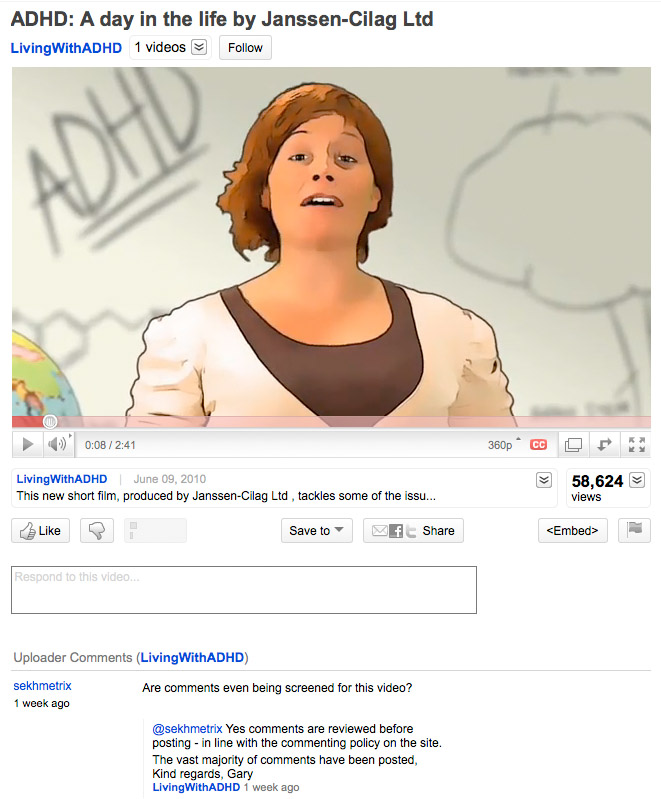
Today, I discovered (hat tip to @andrewspong) that Janssen-Cilag, Ltd, part of the Johnson & Johnson family of companies, is probably the first European pharmaceutical company to produce a non-branded disease awareness YouTube video that allows comments and "Likes." The video is entitled "ADHD: A day in the life by Janssen-Cilag Ltd." You can view the video here or see embedded version at end of this post. But just in case it is pulled in the future, here's a screen shot:


According to the channel notes "This new short film, produced by Janssen‐Cilag Ltd , tackles some of the issues surrounding Attention Deficit Hyperactivity Disorder (ADHD) from the perspective of a child with the condition. For more information visit www.livingwithadhd.co.uk.

"The film was made after talking to groups of doctors, patients, parents and teachers, who told us that too often people think 'ADHD' is just an excuse for 'badly behaved kids'. The film should help people understand what it's like to actually have ADHD.

"If you know anybody affected by ADHD, please do share this film with them. Together, let's make sure all families get the help and support they need."

The "Commenting Policy" states "All submissions will be reviewed and may not be posted if deemed inappropriate. Comments which are off-topic, offensive, or promotional, will not be posted. Please note that we will not post comments about any specific products or treatments, whether they are sold by Janssen-Cilag Ltd or not."

@garymonk, who apparently is the person responsible for this YouTube site, says that Janssen-Cilag has published the "vast majority" of comments. I believe it because there is "a couple of spats boiling away" according to @andrewspong, another Twitter friend of mine.

The site also allows visitors to vote whether or not they "Like" the video. As of today only 51 votes have be cast (43 like the video, 8 do not like it).

Will this video go viral? So far the video has been viewed 58, 624 times since it was uploaded on June 9, 2010.

It's interesting to note that the Johnson & Johnson (JNJ) YouTube video, "Brad's Story: A 12-year old with ADHD," is at the top of the list of related videos. It also allows comments and "Likes." The JNJ ADHD video was uploaded to YouTube back on June 22, 2009 and has been viewed 62,983 times (150 "Likes" vs 12 dislikes). So, by that measure, the Janssen-Cilag video is doing rather well. It should be pointed out that JNJ's YouTube Health Channel includes 302 videos. In all, the total upload views for JNJ's videos is 2,170,352.

JNJ Health Channel's Rob Halper, Director, Video Communication at Johnson & Johnson, is a "Friend" of Janssen-Cilag's Living with ADHD. "Great channel! Terrific contribution to You Tube," said Rob. BTW, Rob Halpert is one of the people nominated (by me) to receive the coveted Pharmaguy Social Media Pioneer Award (see the announcement below).


The Pharmaguy Social Media Pioneer Awards

We might be tempted to give Janssen-Cilag a reward for launching "ADHD: A day in the life" social networking campaign. But instead of having awards for specific pharma social media sites or campaigns, why not give awards to the pioneers who have lead the way? We can learn more from how these pioneers overcame the obstacles to launch social media projects or promote social media than from the end result – even if the end result is flawed. People tend to live much longer than their creations and pharma social media pioneers are no exception. They may move on to new positions and spread their influence far and wide.

Who is @garymonk, for example? I want to know more about this person. How did he get to be in charge of the Janssen-Cilag YouTube ADHD channel? What are the issues he had to deal with? Etc.

That is what the Pharmaguy Social Media Pioneer Award is all about. Let's discover the pioneers and hear their stories. Please use this online form to nominate candidates. The introduction explains the rules for nominating candidates and you can also vote on a dozen or so candidates that I have already chosen.

P.S. I found out who @garymonk is. He is Gary Monk, a Product Manager (Marketing) at Janssen Cilag and, according to his LinkedIn profile, he has already won a few awards such as: The "2009 PM Society Digital Awards - Triple Award Winner (1) Best overall promotional solution (2) Best Integrated Campaign (3) Best Edetail." Nevertheless, I added his name to the nominees for the Pharmaguy Social Media Pioneer Award.