Showing posts with label Mobile. Show all posts

Pharma Social Media Religion Versus Science

My goal in attending conferences like CBI's iPharmaCONNECT, which is currently in progress in Philadelphia, is to come away with at least one new topic worthy of discussion. Thanks to yesterday's session on "What Makes a Health App Effective?" presented by Jim Dayton (@JimDayton), Snr Dir Emerging Media at Intouch Solutions, I have a topic I think worthy: Are we getting too much religion (preaching to the faithful) versus science (useful data) at these conferences?

Dayton was reviewing the story and "success" of GoMeals, the iPhone/iPad/Android app developed by Sanofi Aventis that is intended to help people with diabetes count their calories whether at home or eating out at restaurants. I have reviewed this program in a previous post (read "The iPad as a Pharma Marketing Platform").

One piece of data that Dayton presented was the fact that the GoMeals app has been downloaded about 415,000 times since it was launched in November 2009. Of course, it is widely known that nearly 85% of the people who download apps use them maybe once or twice and then never use them again. I did that with GoMeals. I stopped using it when my favorite local restaurants were not included in the database.

Also, like me, maybe many people downloaded the GoMeals app to multiple devices (eg, iPhones and iPads).

Thus, the number of downloads of an app is NOT a useful KPI (Key Performance Indicator), IMHO.

Dayton did mention that GoMeals enjoyed an abandon rate slightly less than the 80-85% average I mentioned above. But he couldn't (or wouldn't) give the audience any hard data regarding that or practically anything else that might be considered a true KPI.

Dayton, of course, is limited in what he can reveal about his client's product. It's obvious, however, that Sanofi considers GoMeals a success because it has continued to update the program and supports it with a web site and a twitter account. All of this requires a certain commitment of resources. But is this commitment justified by relevant data or just because the faithful believe in the program? Do you justify money spent by science or by religion?

Sanofi obviously collects useful data from GoMeals users. For example, the application includes a survey that asks questions such as:

  1. Do you or anyone in your household who uses GoMeals have diabetes?
  2. How often do you use GoMeals?
Answers to these critical questions would provide some true KPIs. Unfortunately, we don't know what the answers are unless Sanofi chooses to reveal them.

That lead me to ask an unusual question during the panel session yesterday; namely, why doesn't Sanofi reveal these data? The only answer I got was that GoMeals was considered an important part of the marketing plan and therefore that information was proprietary.

I understand that there is a lot of competition among pharma companies in the Type 2 diabetes arena and a lot of this has to do with diets, meals, and menus rather than the benefits of the drugs being marketed (see "Three Companies Compete for Diabetes Market Share Using Recipes Rather Than Product Efficacy"). If competing on helping diabetics with meal planning is the most important part of your marketing plan, then sure, you got to keep this stuff secret.

But how important are mobile apps in pharma's integrated marketing approach? It's got to be a very small part of the pie in terms of resources. If Sanofi revealed what percent of the GoMeals users actually had diabetes, would that be giving too much away?

Why should pharma companies reveal more hard data that can prove (or disprove) the effectiveness of social media and mobile apps? If the SM and mobile evangelists want to convince us that pharma should be doing more in this area, they need to give us some hard data in support of that. If they hide these data and just report "soft," meaningless numbers, I think they are preaching, not teaching.

Pfizer Mobile Public Toilet App Rated Top 25 by George Costanza

I just love following Fabio Gratton on Twitter. Yesterday he posted this tweet:

"Has anyone download this Pfizer app? (only available in Israel). Terrific idea! http://t.co/JAMzbIa4 #mhealth"

When Fabio says something is terrific, I have to see it.

The app he was talking about is Pfizer’s ‘public restroom’ iPhone app, which targets consumers in Israel. BTW, there are in fact no public toilets in Israel!

So, how do you find a public toilet where there is none?

"We launched a GPS app that locates the nearest toilet – restaurants included!”, said Tali Rosin, public affairs and policy manager with Pfizer Israel. According to a reviewer (here), "users can add toilets not already in the app’s database, and can also grade toilets they visit for criteria such as cleanliness, availability of toilet tissue, or whether they needed to ask for a key."

Now THAT's a mobile app that George Costanza would rate among his TOP 25! Actually, Pfizer's app was among Apple App Store’s coveted “Top 25” most-downloaded apps and was downloaded over 15,000 times in about 3 months after it was launched in September 2011.

You could refer to this app as the Mobile George Costanza Public Toilet Finder:


The app is designed to raise awareness about Overactive Bladder (OAB). People with OAB would find this app useful because the condition is characterized by frequent urges to urinate. I bet it's also useful for tourists.

NOTE: It's only useful if the database includes good coverage of a city with lots of ratings from other users. Otherwise, it's a simple matter to walk into any restaurant and ask to use the toilet. You don't need an app for that! I suspect there are a lot of "George Costanzas" out there who may not have OAB, but like to know where the best toilets are located, just in case.

The app also includes an RSS function that automatically sends news feeds to the app. I am not sure what kind of news -- maybe tweets from Pfizer. Interestingly, it also facilitates calls from within the app to Pfizer's hotline.

Pfizer claims that the app has a positive ROI and has lead to an increase in product sales (I suppose for Toviaz, its OAB drug; see here).

Mass Media DTC Trumps Mobile Marketing
So why don't we see such "innovative" smartphone pharma apps here in the U.S.?

Simple. We have direct-to-consumer (DTC) BRAND advertising via mass media and the Internet here in the U.S. That EASILY trumps NON-BRANDED disease awareness social media and mobile apps in terms of awareness. That is one reason why pharma's spending on social media and mobile marketing is so minuscule.

Another reason why the availability of DTC marketing in the U.S. leads to minuscule eMarketing is that brand managers spend so much on mass media DTC there is very little left in the budget for "e" of any sort and a big chunk of that goes to building web sites and buying search engine ads to drive traffic to those web sites, IMHO.

FDA Mobile Regulatory Fear Mongering by PhRMA

In a blog post provocatively titled "An App for That, But For How Much Longer?" (here), PhRMA's Kate Connors agreed with a Washington Times op-ed piece that suggested the FDA will soon require apps such as medication prescription renewal reminders and blood glucose level tracking functions to be regulated as medical devices. You can read the op-ed in this threaded archive: "How safe is that app? Should pharma apps be registered as medical devices?".

The op-ed author, Joel White, executive director of the Health IT Now Coalition, "suggests that this effort would lead to increased costs as well as constraints on user access to these apps, which 'may cause developers to move on to other, less burdensome endeavors.' In the end, this could hinder the way that patients can actively improve their own care," said Conners.

Before I get to destroying the case made by Connors and White, I should point out how these two people are related. White is the president of JC White Consulting, a registered lobbying firm (see here) retained by the Health IT Now Coalition and PhRMA, among others (see here). In her blog post, Connors said "A few days ago, I missed an op-ed in the Washington Times that I just came across today – and I’m glad I did." Joel, you should have DM'd Kate! Whatever! It's nice that White gets paid to write this "independent" op-ed piece that PhRMA can cite as if it were independent! Guys! Wake up! It's the era of transparency! Unfortunately, you can fool some -- maybe even most -- of the people all of the time and that is what keeps PhRMA in business.

Anyway, back to "FDA Mobile Regulatory Fear Mongering." I say "fear mongering" because it can't be true that White and Connors failed to read FDA's July guidance in which it stated that the agency does NOT consider the following types of apps to be mobile medical apps for purposes of the guidance:
"Mobile apps that are solely used to log, record, track, evaluate, or make decisions or suggestions related to developing or maintaining general health and wellness. Such decisions, suggestions, or recommendations are not intended for curing, treating, seeking treatment for mitigating, or diagnosing a specific disease, disorder, patient state, or any specific, identifiable health condition. Examples of these apps include dietary tracking logs, appointment reminders, dietary suggestions based on a calorie counter, posture suggestions, exercise suggestions, or similar decision tools that generally relate to a healthy lifestyle and wellness."
PhRMA/White do not quote FDA because to do so -- as I just did -- would kill the argument that FDA mobile guideline/regulations will stymie pharma from developing apps and will "hinder the way that patients can actively improve their own care." You should also read "No, the FDA is not assaulting mobile technology, Washington Times editorial misguided" published by iMedicalApps.

Meanwhile, there are medical apps being created by pharma that SHOULD be regulated by the FDA, IMHO. These are "calculator" apps designed to be used by physicians during diagnoses. One such app had to be "recalled" because of a bug that generated incorrect results. Unfortunately, thousands of physicians may not have heard of the "recall," which merely removed the app from app stores, not from the phones of physicians who downloaded the app. These physicians may still be using the buggy app. See "The Problem with Unregulated 'Calculator' Apps for Physicians: Buggy Software!"

P.S. Connors pointed out that PhRMA has its own medication reminder app for patients: "In fact, we at PhRMA have helped support the Script Your Future campaign, which itself includes medication reminders as a tool."

Just for fun, I signed up to receive reminders. I was, however, somewhat put off by the long legal disclaimer, which said, in part:
"You acknowledge and agree that we provide the reminder service and access to the reminder service as an "as is" and an "as available" basis, that your use of the reminder service is at your own risk, and that we make no representations, warranties or covenants whatsoever with respect thereto. For greater certainty, we do not guarantee that the reminder service will be available, run error-free or uninterrupted, that we will correct all errors or deficiencies related thereto or that all messages sent by you will arrive at their intended destination on time."
ROTFL! In essence, PhRMA says it makes no promises that this app will be useful. How is this supposed to help me improve my care if PhRMA does not even care to fix errors or deficiencies? Not a very consumer-friendly attitude, I must say! BTW, I am sure the FDA did NOT require PhRMA to write that.

The Problem with Unregulated "Calculator" Apps for Physicians: Buggy Software!

At this year's ePharma Summit in New York, I spent a lot of time listening to presentations about pharma mobile apps. There was, for example, a session entitled "I Wish I'd Done That! Mobile" during which panel members reviewed mobile applications they liked but that were produced by rival pharma companies. Surprisingly, although at least one panel member -- Jason Appel, Director, Physician Relationship Marketing, Amgen -- was involved in creating mobile apps for physicians, only consumer-oriented apps were featured.

Appel said he hasn’t seen any mobile physician apps that he wished he had done and agreed with a previous presenter that most were a waste of money. But of the literally hundreds of apps created by pharmaceutical companies, many are for healthcare professionals.

My friend @skypen (Fabio Gratton) has created a web site to keep track of them all -- it's called POCKET.MD. Fabio claims it is "the world's first and only free online service focused exclusively on providing the most comprehensive directory of mobile applications created by healthcare companies for medical professionals, patients, caregivers, and consumers." Here's a screen shot (click on it for an enlarged view):


Practically every pharmaceutical company has one or more apps. The ones I am interested in are apps designed to help doctors in their diagnosis of patients. Big among these are the "calculator" apps, which calculate things such as glomerular filtration rate (GFR), Medication Adherence Rating Scale (MARS), Delayed Graft Function (DGF) Risk, creatinine clearance, dosing algorithms, Body Mass Index (BMI), and, my favorite, Psoriasis Area and Severity Index (PASI).

According to POCKET.MD, the most downloaded app is Pfizer's "Pfizer Rheumatology Calculator" - a rheumatology disease activity calculator that Pfizer developed to allow physicians to "quickly and easily measure the disease activity of your patients without having to use manual calculations. The calculator is easy to use -- simply enter clinical data for your patient into the calculator and it will instantly provide you with the score in a variety of disease activity measures, including: ASDAS ESR & CRP BASDAI DAS28 ESR & CRP PASI And more..."


Unfortunately, this free Pfizer app is no longer available -- it had to be recalled because of "a bug in the app ... gives wrong results" (see "Pfizer recalls Rheumatology Calculator smartphone App").

Back in July, 2011, I warned that bugs in such apps could go un-noticed because there is no independent verification of the software -- no "Good App Seal of Approval" and certainly no FDA approval. See "Checking Under the Hood of Pharma Mobile Apps" where I point out this shortcoming in another PASI calculator mobile app.

But how do you recall a smartphone app? You can remove the app from the app stores around the world, which is what Pfizer did, but that only prevents new downloads. Most apps are downloaded to smartphones and it is not possible for the developer to remove these copies of the app from the phones. The users must do that. Considering that the "recalled" Pfizer app was the most downloaded app tracked by POCKET.MD, there must be many many users (physicians) out there who still have the app on their phones. Did Pfizer send these physicians a "Dear Doctor" letter informing them of the problem and advising them to remove the app from their phones? Probably not. Did the app include a disclaimer that protects Pfizer from being responsible for misdiagnoses due to its buggy app? Probably yes.

Is There a Cure for Mediocre Pharma Mobile Apps?

For new pharma marketing Graduates, I have just one word for you. Are you listening? Mobile!

Mobile is the new "shiny thing" of interest to pharmaceutical marketers. As evidence of this, there are more and more drug industry conferences that are dedicated to mobile or have tracks or whole days dedicated to mobile. Mobile Healthcare Communications 2012, for example, is one of them. I will be at that conference moderating a roundtable discussion on "Overcoming Mobile Healthcare Compliance Challenges." [The producers of that conference are a client, but I am not being paid to write this post.]
According to my currently-running "Predicting the Future of the Drug Industry: 2012 and Beyond" survey, 72% of respondents agree/strongly agree that the next "BIG opportunity for targeted marketing to patients and physicians is mobile apps on smart phones."
Until recently there were not many pharma mobile applications out there worthy of writing about. previously. Most marketers were discussing only SMS (text messaging) as the best example of using mobile to motivate people to take their medicine. Boring!

I have written about issues related to use of mobile devices by pharma, including the following posts and articles:
However, most pharma mobile apps that I have seen are pretty mundane as far as marketing/advertising is concerned. There are a few that focus on consumers such as the Sanofi-Aventis GoMeals app, which IMHO has absolutely no marketing ROI for S-A although it is only one part of an overall marketing plan to position S-A as a player in the diabetes area.

Other apps are aimed at physicians, such as Janssen's "Psoriasis" (PASI) app for the iPhone and iPad that may need FDA approval as a medical device (see here).

There are no pharma apps that I know of that directly help to sell drugs or vaccines. I mention vaccines because I just found out about a P&G "Vicks" branded mobile app/device combination that could be a model for improving the sale of vaccines, especially for the flu. It's a mobile advertising campaign for a behind-the-ear thermometer by Vicks that is "designed to display the ad only in areas where there is a high incidence of the flu and only to mothers, the primary purchasers of thermometers" (see "Using Google Data on Smartphones to Target Consumers for Ads").

Couldn't an app like this be created by a pharma company to promote its flu and other vaccines? Or even OTC medicines during allergy season? Perhaps even Rx drugs if Google had the right kind of targeting data?

There are, of course, some regulatory hurdles to overcome. Since the Vicks app is integrated with a device (thermometer), perhaps it should be regulated by the FDA as a medical device.

Another challenge is the relationship between Google and the pharma industry. While Google is bending over backwards to provide help to consumer goods agencies about how best to do display advertising via its network (see "Google Increases Investment in Display Ads"), I don't think Google is providing the same level of services to pharma agencies. A representative of Google recently said "pharma needs to leverage the Internet" and that "pharma was not considered a key client by Google because of pharma’s low spend" (see here).

To create truly useful mobile apps that have ROI, pharma needs to invest more in interactive media overall. Otherwise, it will continue to develop marginally useful apps that are used once and then forgotten, IMHO.

Predicting the Future of the Drug Industry: 2012 and Beyond

It's time to revisit a survey I ran a couple of years ago that attempted to predict future healthcare market scenarios that would impact the drug industry. The survey asks respondents how likely it is for certain events or conditions to unfold in the next 5 to 8 years (ie, 2012 to 2019).


Predicting the Future of the Drug Industry: 2012 and Beyond


You can take the survey here. But before you do that, let's review the first-round of results (ie, responses collected from 2 December 2009 through 8 January 2010). Events since then may have made some of the following scenarios more or less likely. You tell me.

The scenarios -- with my updated comments included in brackets [] -- that are included in the survey are as follows (see the chart afterward for the first-round results):
  1. New follow-on biologics legislation in the U.S. will increase competition from generic equivalents and eventually decrease brand profits. [I think the legislation is still bogged down and when finalized may not have much impact within the time frame specified.]
  2. Broadcast (ie, TV) Direct-to-Consumer (DTC) drug promotion will be banned or sharply curtailed by law in the U.S. [This may have been a big issue back in the day, but it doesn't seem to be center stage right now.]
  3. The European Union will finally allow Direct-to-Consumer (DTC) advertising to its citizens. [The European Commission, the executive arm of the EU, recently ruled that pharma companies would not be allowed to disseminate information about drugs and their indications beyond a narrow set of circumstances. For the details, see, "In Rejecting Proposal, EU Dashes Drugmakers’ Hopes of Having a Voice"]
  4. Internet-based drug promotion (including search engine marketing) will overtake TV-based DTC in the U.S. in terms of dollars spent. [There's still time for this to happen. I'm guessing that right now only about 5% (maybe 10% if you include search advertising) of pharma's DTC advertising budget is spent on Internet advertising whereas TV accounts for over 50% of the budget. See "Double Dip in DTC Spending Plus 33% Drop in Internet Display Ad Spending!"]
  5. Due to decreasing effectiveness of traditional physician detailing and rise of non-personal detailing, the role of traditional sales representative will become obsolete. [I'm surprised that over 50% of respondents think this is likely to happen before 2020 (see chart below). Perhaps a sign is the recent closing of Pharmaceutical Representative Magazine (see here). Also read this article: "Consequences of eDetailing Technology".]
  6. New healthcare reform legislation will dramatically increase the sales of drugs in the U.S.
  7. Extensive outcomes data available to payers and comparative effectiveness research will force the industry much further down the path of pay-for-performance (ie, adopt a more flexible approach to pricing). [For background in this, read the article "A Case for Supporting Comparative Effectiveness Research".]
  8. Patients will become even more influential and empowered in making healthcare decisions as they are forced to pay a larger share of costs and/or have access to health information from a variety of sources. [For more background on this, read the article "The Empowered Patient: What It Means for Pharma Marketers".]
  9. Despite lack of innovative new drugs and/or generic competition, sales of brand drugs worldwide will show a sharp increase due to increased demand in emerging markets (eg, China). [See the following articles: "Getting Market Research Right in Emerging Markets", "Getting Market Research Right in the Middle East", and "Getting Market Research Right in India & China".]
  10. More efficient targeting of drugs and marketing to specific patient populations will greatly increase effectiveness and decrease side effects of drugs. [See, for example, "New Big Pharma Economies of Scale: Less Patients Needed to Reach Blockbuster Sales". At least one targeted therapy (I can't recall which), however, recently failed and that may cast a shadow on progress in this area.]
  11. Social media marketing will become a significant part (>10%) of the pharmaceutical marketing mix. [Hmmm... A lot of people seem to believe this is likely (see chart), but FDA's delay in issuing guidance may have dampened the outlook for pharma use of social media.]
  12. The next BIG opportunity for targeted marketing to patients and physicians is mobile apps on "smart phones." [To prepare for this, I recommend you read the article "Everything You Need to Know About Mobile Platforms". Take the survey and you will get a discount code that allows you to get this at no charge.]
  13. Pharmaceutical and biotech companies will continue to increase their outsourcing of clinical trials and related drug development. Outsourcing will account for more than 50% of R&D spending by 2019.
The following chart summarizes first-round (prior to January 2010) survey results. Please take the survey now and help me get a more current view of what may be dow the road.


Games vs. Mobile Health Monitoring Devices: Which is a Better Motivator?

What could possibly justify spending $8,000 for an electronic mobile ultrasound device vs. $100 for a stethoscope? Keep in mind that the stethoscope will likely last a lifetime, whereas the electronic device -- like my son's iPod -- may last only a couple of years before failing or becoming obsolete even sooner.

"Why would I listen to 'lub dub' when I can see everything?" said a doctor quoted in today's Wall Street Journal (see "Can Mobile Monitoring Devices Improve Medical Treatment?"). "Dr. Topol, a cardiologist in San Diego, carries with him instead a portable ultrasound device roughly the size of a cellphone [see image]. When he puts it to a patient's chest, the device allows him to peer directly into the heart. The patient looks, too; together, they check out the muscle, the valves, the rhythm, the blood flow."

Doctors, especially cardiologists, are notorious gadget geeks, so you have to take their enthusiasm for electronic devices with a grain of salt, especially when they claim that the devices will improve health care.

"[Dr. Topol] and other physicians say the technology can not only improve diagnoses and treatment, but also revolutionize how doctors and patients think about health care. Mobile tools allow physicians to monitor vital signs, note changes in activity levels and verify that medications have been taken, without ever seeing a patient face to face."

I wasn't aware that physicians were even interested in "verifying that medications have been taken" let alone that they would buy expensive devices to help them do that. Most physicians don't want to take on that responsibility and be legally liable. Also, who will pay for the service, especially when the physician makes a substantial investment in devices? The same goes for "monitoring vital signs" and other forms of monitoring patients from afar. "We're getting virtual touch, rather than actual touch," says Dr. Topol.

Dr. Topol "found that many [of his] patients are more willing to make lifestyle changes that keep them healthy when they can monitor the consequences of their actions in real time. A doctor can talk 'until he's blue in the face,' he says, but it sometimes takes cold, hard data to motivate a patient."

Social gaming enthusiasts disagree. "We tried to give people constant feedback about [patients'] health, but for a lot of people, more bad news and negative feedback just didn't work," said Adam Bosworth, the chief technology officer at Keas Inc., whose clients include Pfizer Inc. and Novartis Inc. "If you keep giving someone negative feedback, they will eventually change the channel to the game channel. One day we decided to become that game channel." Bosworth was quoted in another Wall Street Journal article published today (see "Health Care Social Gaming Start-Ups").

So, which technology is better for helping people change their lifestyles and improve their health? Social media games or remote monitoring devices?

Which technology is better at helping change behavior & improve health?
Mobile social gaming apps
Mobile remote monitoring devices
Both are effective.
Neither are effective.
I don't have a clue!


Be Aware of What's Behind a Pharma Mobile App: Disclaimers Only Tell Part of the Story

Some time ago, I pointed out that certain mobile apps developed by pharmaceutical companies for use by physicians lack adequate disclaimers. Specifically, I was concerned about the software used in these apps that perform calculations to generate data to aid in medical diagnoses. A Psoriasis/PASI app by Janssen Pharmaceutica is an example (see "FDA Promises Still More Guidance! This Time It's Mobile. Janssen's Psoriasis iPhone App May Need It"). I pointed out that this app does NOT include any information about the clinical validity of the PASI calculator nor does it warn the user not to depend on the accuracy of the data.

Today, I found out about AFib Educator 2.0 developed by Sanofi-Aventis (I seemed to have missed 1.0!). The app is intended to be an "interactive way for healthcare providers to illustrate atrial fibrillation and its pharmacologic management for patients and families" (see review on iMedicalApps blog). The "pharmacologic management" is not what you may think; that is, there is no mention of any AFib drug either by trade name or generic name. The app only mentions that "there are treatments available."

Let's look at the disclaimers for these two apps (click the image for an enlarged view):


On the left is the disclaimer for Sanofi's AFib Educator 2.0 and on the right is the disclaimer for Janssen's PAS calculator (updated since I last reviewed the app).

Both disclaimers mention that the app is "not a substitute for medical advice/professional medical care". But only the AFib disclaimer mentions that "Persons using the data within for medical purposes should not rely solely on the accuracy of the data herein." It also mentions that data might be updated periodically -- meaning, I suppose, corrections or more accurate data.

Why doesn't Janssen's Psoriasis/PASI app, which is MUCH more data driven (it calculates a PASI score!), include a similar warning? Obviously, I think it should include that warning.

But more importantly, Janssen's app should include information about the source of the equation it uses to calculate PASI. As I pointed out previously (op cit), there is some difference of medical opinion regarding how PASI should be calculated and which formula should be used by healthcare professionals.

Obviously, ANY healthcare professional can download and use the PASI app. You don't have to be a dermatologist who may be more familiar with PASI calculations than is a general practitioner. In fact, you don't have to be a physician at all! That's fine, but the audience should be made more aware of what's operating "behind" the app to generate the PASI scores.

Be Aware of What's Behind the App
What's going on "behind the app" is a hot topic these days. Recently, major news outlets have reported that there is software running in the background on virtually all smart mobile devices that record every keystroke, supposedly merely to "monitor performance" (see "Is Your Smartphone Tracking Your Keystrokes, Texts and Location?" and the YouTube Video embedded at the end of this post).

It's interesting that part of Janssen's NEW disclaimer HINTS that data are being collected when people use its Psoriasis/PASI app (see screen shot below).


Janssen claims that it is monitoring clicks for performance purposes. However, since it is possible to collect and record ALL keystrokes, there is the possibility that data other than icon clicks are being collected by Janssen. I'll have to see if Trevor Eckhart -- who made the video below -- will take a look at exactly what data the Janssen apps records.


Gov't SoMo Media Aimed at Teen Smokers: We're Not Telling You What to Do

I just learned that the National Cancer Institute (NCI) has launched a Mobile phone app ("SmokefreeTXT") and a social media campaign designed to help teens quit smoking (see "Nci Launches Smoking Cessation Support For Teens").

SmokefreeTXT is a free text message cessation service that provides 24/7 encouragement, advice, and tips to teens trying to quit smoking.

"Once they sign up, teens receive text messages timed according to their selected quit date. Following their quit date, they will continue receiving texts for up to six weeks -- a critical piece of the SmokefreeTXT service, as research shows that cessation support continues to be important beyond the first few weeks of quitting. Teens can sign up online at or text QUIT to iQUIT (47848)."

An image of an iPhone with a quit smoking text message is shown on the left (click on it for an enlarged view).

I hope it's more personalized, so instead of saying "Teen: SUCKY" it says something like "John feels SUCKY today." Maybe with a little sad face emoticon :-( afterward.

I like the encouraging message, however. "Do something positive. Get your zumba on, shoot some hoops, or crank up your iPod."

There's also a website (here),  @SmokefreeTeen Twitter account, and a FaceBook page (here). I call this type of campaign "SoMo" because it combines social media with a mobile app. It would have been nice to integrate social media INTO the mobile app -- eg, have quit smoking buddies and see how THEY are feeling today right on your iPhone (or iPad).

The About SfT page notes that "We're NOT ging to tell you what to do." As if anyone can tell teenagers what to do!

One of the things I like about social media is how easy it is to see how "successful" campaigns like these will be. We can always look at how many followers a Twitter account has and how many "Likes" a Facebook page gets. It's always possible, however, to game the system and artificially inflate the number of your Twitter followers or Facebook likes. But that's another story (see "How Did Pfizer Get So Many Twitter Followers?").


FDA Issues Long-Awaited Guidance - for Mobile Medical Apps. Janssen, Look Out!

While one arm of the FDA -- the Division of Drug Marketing, Advertising, and Communications (DDMAC), the arm responsible for regulating drug promotion -- is dragging its feet issuing guidance for social media promotion (first promised for 2010, now completely off the 2011 guidance calendar; see "FDA Drops Social Media from Its 2011 Guidance Agenda"), two other arms -- the Center for Devices and Radiological Health (CDRH) and the Center for Biologics Evaluation and Research (CBER); responsible for regulating medical devices -- has issued guidance for mobile medical applications (see "FDA outlines oversight of mobile medical applications" where you can download the guidance document).

The guidance focuses only on a select group of applications and goes out of its way to assure the public that the FDA "will not regulate the sale or general consumer use of smartphones or tablets."

As you know, there are probably thousands of consumer-focused health apps available for smartphones. The guidance carves most of these out of its regulatory bailiwick. According to the guidance, the following represents mobile apps that FDA does NOT consider to be mobile medical apps for purposes of the guidance:
"Mobile apps that are solely used to log, record, track, evaluate, or make decisions or suggestions related to developing or maintaining general health and wellness. Such decisions, suggestions, or recommendations are not intended for curing, treating, seeking treatment for mitigating, or diagnosing a specific disease, disorder, patient state, or any specific, identifiable health condition [my emphasis]. Examples of these apps include dietary tracking logs, appointment reminders, dietary suggestions based on a calorie counter, posture suggestions, exercise suggestions, or similar decision tools that generally relate to a healthy lifestyle and wellness."
I highlighted the wording that determines whether or not FDA might consider health apps subject to being regulated as medical devices: "not intended for curing, treating, seeking treatment for mitigating, or diagnosing a specific disease, disorder, patient state, or any specific, identifiable health condition."

The guidance defines what would make an app a mobile medical app subject to regulation as:
"When the intended use of a mobile app is for the diagnosis of disease or other conditions, or the cure, mitigation, treatment, or prevention of disease, or is intended to affect the structure or any function of the body of man, the mobile app is a device."
"One example," says the FDA, "is a light emitting diode (LED) included on a mobile platform with a mobile app to make that LED operate. If the manufacturer intends the system to illuminate objects generally (i.e., without a specific device intended use), neither the mobile app nor the mobile platform would be considered medical devices. If, however, through marketing and distribution, the mobile app is promoted by the manufacturer for use as a light source to examine patients, then the mobile app would meet the definition of a device. (In this case, the intended use of the light source would be similar to a conventional device such as an ophthalmoscope.)"
Are there any pharma developed and promoted mobile apps that fit this definition and thereby SHOULD be regulated as a medical mobile app?

YES, THERE IS!

Back in March, I suggested that Janssen's "Psoriasis" app for the iPhone and iPad may be a candidate for regulation as a medical device. You can read all about that in this blog post: "FDA Promises Still More Guidance! This Time It's Mobile. Janssen's Psoriasis iPhone App May Need It" and in this Pharma Marketing News article: "Pharma SmartPhone/Tablet Apps. Is There a Regulation for That?"


One of the questions I had about Janssen's Psoriasis app concerned the accuracy of the formula used to calculate PASI ("Psoriasis Area and Severity Index"), which is a tool for the measurement of severity of psoriasis. The app is intended for physicians to use in diagnosing their patients. Suppose there was a "bug" in the program that calculated the PASI score? It seems that such software needs to be regulated as a medical device by the FDA.

In fact, I notice that there is an update available for Janssen's Psoriasis app. It was issued on 31 May 2011, about a month and a half after I blogged about the app. The note relating to the update merely states "bug fix." Could there have been a "bug" -- ie, ERROR -- in the formula used?

I updated my iPhone version of Janssen's Psoriasis app, but I do not notice any difference in the app nor the instructions that come with it. The "bug fix," therefore, could actually involve the software that calculates PASI.

Regardless of whether such pharma apps may be regulated by FDA as medical devices, I strongly believe that developers of health-related apps should explain in detail what "bugs" were fixed so that users have an idea of how the "bug" may have affected them. Shame on Janssen for not being more transparent in this regard!

[This post originally appeared in Pharma Marketing Blog
Make sure you are reading the source to get the latest comments.]

GSK, National Headache Foundation and "Migraine Diary." Is There an App for That?

Last week I came across this tweet posted by @GSKUS:
RT @NHF: Need help remembering your #migraines details? Find an online migraine diary from @GSKUS at http://bit.ly/hBS98Q
For my Twitter-challenged readers, I should point out that "RT" signifies that @GSKUS "retweeeted" a tweet originally made by @NHF, which is the Twitter account of the National Headache Foundation.

Whenever a pharma company retweets a message from a third party, it raises some flags. For example, suppose NHF was a patient advocacy organization that promoted off-label use of medications and suppose those medications were marketed by GSK? Further, what if GSK helps support NHF with funding? What if NHF received the majority of its funds from GSK? What if NHF was actually created by GSK and not independent at all?

I am asking these questions because I have previously cited the close relationship between GSK and a supposedly independent Restless Leg Syndrome patient advocacy organization (see Pharma Dollars (Pounds, Euros) are Grassroots Seeds).

These days there are quite a few tools I can use to answer my questions. But, first, let's look at the link in the tweet.

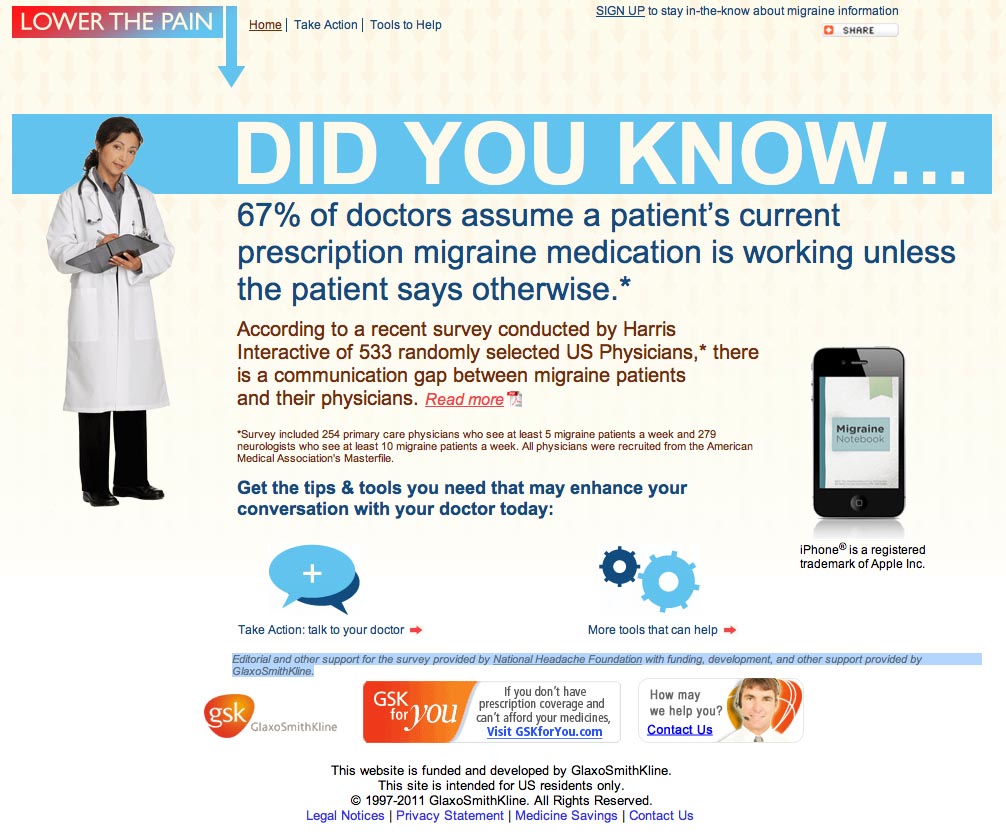
When you click on the http://bit.ly/hBS98Q link in the GSKUS tweet, you discover that the real link is http://www.lowerthepain.com/pdf/Migraine_Diary.pdf. The "Lower The Pain" website (www.lowerthepain.com) is a GSK site that prominently promotes a migraine survey. "Editorial and other support for the survey provided by National Headache Foundation with funding, development, and other support provided by GlaxoSmithKline," says GSK on the site. See this Fact Sheet on the NHF site for more about the survey.


But I also see an invitation to get "tips & tools you need that may enhance your conversation with your doctor today." Right NEXT to that is a picture of an iPhone, which GSK is careful to point out is a registered trademark of Apple Inc.

When I click on "Tools to Help" I am brought to the following screen:


This further HINTS that there is an app for that (ie, "MIGRAINE DIARY").

So, is there an iPhone version of the Migraine Diary?

Yes, there IS an iPhone "Migraine Diary," BUT it does NOT appear to be a GSK app or an NHF app. Here's the app by that name that I found on iTunes:


This is a nice little app, but it does NOT resemble the GSK's PDF version of "Migraine Diary."

The iPhone app was developed by Net Workz LLC, a Software Engineering Firm located in the UK, which is the only connection I can see between it and GSK. In fact, the creator of the app is Aaron Douglas. His about page states that "Net Workz LLC is a small company I started that I use for anything I do geeky-related. I don’t have much content here but I plan on expanding this site soon. My full time job employs me as a software engineer. This place is for my personal projects that need to be legit, like iPhone Apps."

Maybe GSK and Douglas are negotiating a deal right now to allow "Migraine Diary" to "go legit."

The only comment Douglas has received about his app is this:
"I like this app. It's not the fanciest, but I wanted something easy to fill out when I'm in pain! The only problem I have is that sometimes when I add a journal entry, it only shows up when I turn it off then on again, but it is there. I wish it had more graphs to see more than one month, to see a patten. An option for an "all day" headache instead of having to put in a time would be good!"
OK, so what about the relationship between GSK and NHF? There's obviously the survey mentioned above. There's a guest post to GSK's blog by Merle L. Diamond, MD entitled "Teaming up to Close the Gap in Doctor-Patient Migraine Communication" (see here). "Dr. Merle L. Diamond was compensated by GlaxoSmithKline for her participation in this campaign," GSK disclosed. Dr. Diamond is a member of the NHF board of directors.

Dr. Diamond is daughter to Seymour Diamond M.D., Executive Chairman of NHF, who originally founded the National Migraine Foundation, which was renamed the National Headache Foundation in 1987.

Seymour Diamond is the also the founder of Diamond Headache Clinic and Merle Diamond is it's president.

I'm not going to track this much further, but it would be interesting to know how many other physicians involved with NHF and the Diamond Headache Clinic are on GSK's payroll. Now that GSK has been required to list all payments to physicians, it should be easy to find out.

OK, I will track this a bit further. I just downloaded NHF's 2009 IRS Form 990, which has some interesting tidbits an accountant may be able to dechiper.

I notice, for example, that NHF made a "gift" of $1,112,748 to the Seymour Diamond Fellowship Fund [of] the Diamond Headache Clinic Research and Education Foundation. Are the Diamonds using the NHF as their personal piggy bank?

Also, NHF paid $814,955 to Vedanta Associates Inc., an independent contractor, for "research on various projects and programs." Seems like a lot of money for "research." What I've been able to find out about Vedanta Associates is it "provides marketing research and medical communications solutions to the pharmaceutical and heathcare industry."

FDA Promises Still More Guidance! This Time It's Mobile. Janssen's Psoriasis iPhone App May Need It.

"The Food & Drug Administration is planning to release guidance for mobile medical applications in 2011, according to Center for Devices and Radiological Health director Dr. Jeffrey Shuren." That was reported in this story relaying comments made at a "town hall meeting" held March 10 in Irving, Texas.

I don't know nearly as much about Dr. Jeffrey Shuren as I do about Tom Abrams, his counterpart in FDA's DDMAC. But if he's making more promises that the FDA hasn't the ability to keep, then I urge that he resign along with Tom Abrams (see "Is It Time for Abrams to Leave?").

As you probably know, DDMAC first "promised" that it would issue social media guidance for pharmaceutical promotion by the end of 2010. When they missed that date, Abrams "promised" it would be done by the end of Q1 20011, which leaves only about 2 weeks for the FDA to fulfill that "promise."

Most observers, however, believe FDA will not deliver social media guidance before April Fool's Day 2011. Considering the looming budget cuts suggested by some anti-government bloat lawmakers, it could be a cold day in hell before FDA can spare the resources to get the job done as "promised."

Regarding mobile devices FDA has a much, much greater challenge in issuing guidance. The issue has to do with agency approval of Mobile medical applications as medical devices. So far, FDA has approved two mobile applications:
  1. MobiUS, a smartphone-based ultrasound imaging application for use in obstetric, gastrointestinal, cardiac andother clinical applications.
  2. Mobile MIM, a mobile diagnostic radiology application that facilitates viewing of medical images for diagnostic purposes via Apple’s iPhone and iPad devices.
FDA approval of these devices/applications hinged on image quality (see FDA Press Release). Of much greater concern, however, are applications that involve more complicated software. Whether or not the FDA would regulate mobile software has been an issue for nearly two years.

Is the FDA technologically competent enough to evaluate mobile App software? It's a valid question considering that many people have doubted that FDA was competent enough to understand social media and issue guidance in that realm. Software, which operates behind the scenes, is even more of a challenge.

Faulty software can make medical devices dangerous. Think of "HAL" in charge of millions of pacemakers. That sort of thing.

There is a relation between mobile medical Apps and pharmaceutical marketing. Many pharmaceutical marketers are developing mobile Apps. The latest one I've come across is Janssen's "Psoriasis" app for the iPhone and iPad (see it here on iTunes).


The physician version -- which any non-physician can easily access -- includes a "PASI calculator." PASI stands for "Psoriasis Area and Severity Index," which is a tool for the measurement of severity of psoriasis. According to the wikipedia entry, the following formula is used to calculate PASI:


I won't get into the details here, but I wonder if this is the equation used in the software that calculates PASI in Janssen's Psoriasis App? Does the software implement the equation correctly? Has it been tested and certified as correct? By whom?

Jannsen does include this statement in its disclaimer: "The information provided on this App is not a substitute for professional medical care." This is par for the course when dealing with consumers who may be using the PASI calculator without medical supervision.

But I can't find any information about the clinical validity of the PASI calculator, which is an issue I've often blogged about (see, for example, "Pharma Symptom Quiz Goes to the Dogs!" and links therein).

This is just a simple example of a medical App that depends on the accuracy of its software to function properly. If marketers design the Apps and hire outside tech agencies to develop the Apps, then there is the possibility that the software can be "gamed" to provide desired results (eg, higher PASI score) much like the software of Vegas slot machines are "gamed" to favor the house.

Is the Janssen Psoriasis App a medical device that needs to be approved by the FDA? I think that's a valid question to ask since the App encourages physicians to use it: "This interactive PASI calculator enables you to generate a PASI score for your patients."

P.S. Janssen says that the Psoriasis iPhone App is "Intended for a European audience." But it -- like ALL iPhone Apps -- is available on iTunes, which is a US retail Web site. Does that trump "intention" and does intention matter as far as the FDA is concerned?

P.S. See "Checking Under the Hood of Pharma Mobile Apps" for an update.