Showing posts with label Pfizer. Show all posts

Retro Relpax Web Site Features Woman Mopping the Floor. Inspirational? Not!

The "DDR on DTC" column in the August 2012 issue of MM&M magazine ripped into a print ad that showed a woman migraine sufferer being able to mop the floor after taking the Pfizer anti-migraine headache drug Replax.

"DTC ads used to be over-aspirational," said the author, Deborah Dick-Rath, "we saw relieved arthritis sufferers running marathons or playing Frisbee. With Relpax, the insight seems to be that sufferers just aspire to do such everyday activities as mopping the floor...We hope that Relpax is a success for Pfizer and that migraine sufferers find relief. We also hope they get (strictly aspirationally) excused from swabbing the deck" (see "DDR on DTC: Relpax").

Here's the ad that DDR reviewed:


This is probably the result of Pfizer's conservative view of what modern women aspire to at 11:00 Am in the morning (note the clock).

I couldn't find this ad in a recent issue of People Magazine, which is the publication in which DDR found the above ad. Instead I found this much more politically correct, although still not too inspirational, ad:


In this version, two hours after taking Replax, the migraine sufferer is able to go out and do whatever her business is -- probably commuting to work given that the clock is showing 8;00 AM (or is it PM?).

Perhaps Pfizer read DDR's column and revised the print ad campaign, at least as far as image is concerned. Surprisingly, however, the Replax.com Web site still portrays the woman mopping the floor:


It appears that it takes longer to swap out a Web image that a print ad image.

Pfizer is asking Replax.com visitors to tell their "stories" by submitting photos or video. "Tell us about your experience with migraines by submitting a story," says the promo page (here). "Your story can include a photo or video. If chosen, your submission could be featured on RELPAX.com."

I don't imagine a single submitted photo or video will feature a woman mopping the floor. Do you?

You can tell that pharma marketers are getting desperate when they have to beg consumers to submit stories to compensate for the fact that their image of the modern consumer dates back to the 1950's.

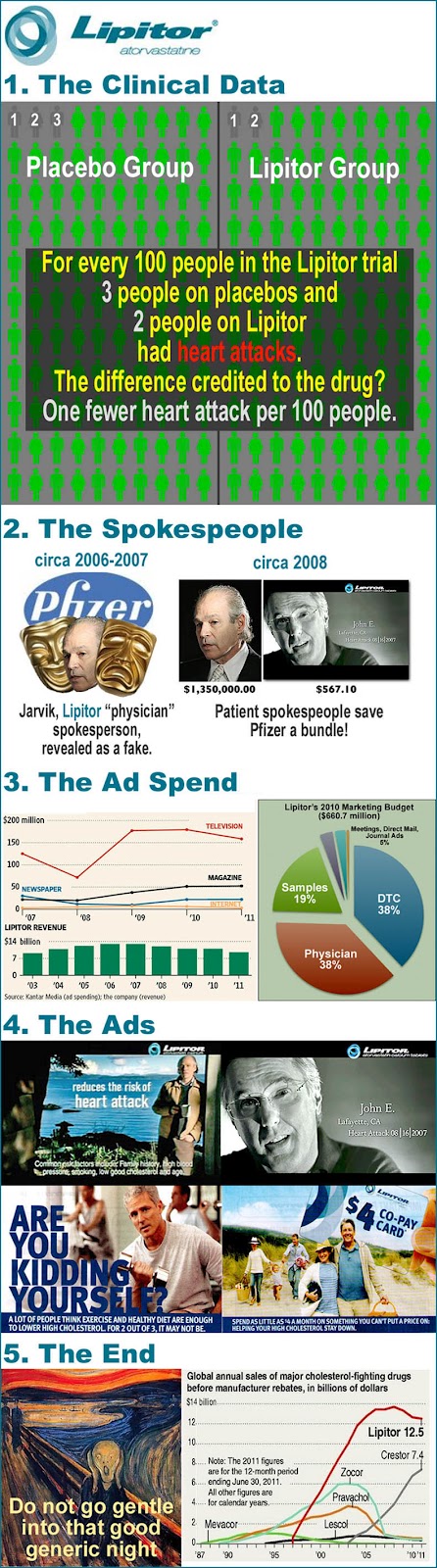
Lipitor U.S. Sales Tank 70% in 2012 vs 2011!

According to Drugs.com, Lipitor U.S. sales in Q2 of 2012 were only 30% of what they were in Q2 2011 ($579 million vs. $1,949 million, respectively (see chart below; Source: http://www.drugs.com/stats/lipitor).


Meanwhile, sales of Crestor (a competitor anti-cholesterol drug) increased only somewhat during the same period (see chart below; Source: http://www.drugs.com/stats/crestor).


I conclude that most of the loss of Lipitor sales was due to direct competition from generic versions of Lipitor now currently available, which is further proof that Pfizer's "innovative" attempts to stem the generic Lipitor tide has failed (see also "Pfizer Throws In the Lipitor Marketing Towel").

Lilly Overtakes Pfizer as Biggest DTC Advertising Spender!

According to cegedim Strategic Data, Lilly overtook Pfizer in total direct-to-consumer (DTC) spending in April, 2012. The chart below shows the top 10 DTC spenders between July 2011 and April 2012.


Pfizer spent nearly $900 million in DTC advertising in 2011. $220 million of that was for Lipitor. I predicted that Lipitor would hold the "Key to DTC Ad Spending in 2012" (see here) and this chart proves it.

Lilly's Cymbalta and Cialis were the #2 and #3 highest in DTC ad spending in 2011. It looks like they will be #1 and #2 in 2012.

Is Type 2 Diabetes Drug Marketing Responsible for Misdiagnosis of Type 1 Diabetics?

A Wall Street Journal article documents several cases of people being misdiagnosed by general practitioners as having Type 2 diabetes when they actually have Type 1 diabetes, "a substantially different condition" (see "Wrong Call: The Trouble Diagnosing Diabetes"). According to the article:

"An incorrect diagnosis usually occurs in the offices of primary-care doctors, many of whom haven't received adequate education in medical school about rising rates of Type 1 in adults and how to diagnose it. 'It is not on their radar because they see so much diabetes and it is by far mostly Type 2,' said Irl B. Hirsch, professor of medicine at the University of Washington Medical Center in Seattle."

As I continued reading, I couldn't help but wonder if the current competition among drug companies to sell Type 2 diabetes drugs has something to do with this. Fierce marketing of these drugs - see box below - may be contributing to emphasizing Type 2 diabetes on GP's "radar screens."

The Three Type 2 Diabetes Drug "Amigos"
  1. Januvia - marketed by Merck
  2. Onglyza - marketed by Bristol-Myers Squibb/Astrazeneca
  3. Victoza - marketed by Novo Nordisk
See "Three Companies Compete for Diabetes Market Share"

In each case cited in the article, misdiagnosed patients were taking oral drugs, none of which were mentioned by name, and none of which are effective or approved by the FDA for treating Type 1 diabetes. "For six years, Mr. Jones [a patient] treated what had been diagnosed as Type 2 diabetes. He changed his diet and took three oral medications daily." It's likely that at least one of those drugs was one of the "Three Type 2 Diabetes Drug 'Amigos'" mentioned above.

Of course, many GPs would probably misdiagnose patients as having Type 2 diabetes when they actually have Type 1 diabetes even without being bombarded with marketing for Type 2 treatments. But having multiple pills available to prescribe makes it easier, in my opinion, to avoid taking the patient down the path to a possible Type 1 diagnosis.

The ultimate responsibility for misdiagnosis, however, must rest with the physician and not the pharmaceutical marketer, unless of course, the marketer offers physicians inducements (ie, money or non-monetary rewards) for prescribing products.

On that note, I also read a story in today's WSJ about Pfizer and other drug companies bribing doctors to prescribe their drugs. Pfizer settled with the DOJ -- admitting nothing -- but paid $60.2 Million to "Resolve U.S. Allegations That It Used Illegal Payoffs to Win Business Overseas."

Of course, such things do NOT happen here in the U.S.

Pfizer and Janssen Halt Alzheimer Drug Development: Why Not Try Gamification?

"In the wake of another negative trial with the anti-amyloid biologic drug bapineuzumab, Pfizer and Janssen said they were halting development of the product for mild to moderate Alzheimer's disease," reports medpage today (here).

Pfizer may have had high hopes for this drug because it already launched a multichannel marketing/PR campaign centered around "getting old" (see "Pfizer's Social Media Initiatives are Getting Old") and this drug in particular (see "Can Pharma Cure Alzheimer's Disease? A Pfizer Pre-Launch Multichannel Marketing Case Study").

I'm not sure what other Alzheimer products Pfizer is currently working on, but maybe it's time for it think out of the box. Perhaps it should look into gamification as an alternative strategy.

You might ask, "Are you serious John? Just yesterday you pooh-poohed gamification as an alternative to ADHD drugs" (see "Cure by Gamification: Science or Wishful Thinking?").

True that. I still believe that games will never be approved by the FDA for treatment of a medical condition and doctors won't prescribe them even if they were approved. But that doesn't mean games cannot be effective in the treatment of Alzheimers Disease by slowing its progression, which has been the goal of clinical trials of drugs like bapineuzumab.

There is actually some SCIENCE published in a peer-reviewed medical journal (JAMA's Archives of Neurology) that purports to have found a link between “brain-stimulating activities” and levels of protein -- ie, β-amyloid -- thought to cause Alzheimer’s disease (see "Brain Games May Help Thwart Alzheimer’s: Study"). The authors of the study state:

"We report a direct association between cognitive activity and [11C]PiB uptake, suggesting that lifestyle factors found in individuals with high cognitive engagement may prevent or slow deposition of β-amyloid, perhaps influencing the onset and progression of AD."

At least one patient support group supports the idea that games might be helpful in thwarting Alzheimer's Disease (see this LivingStrong web site page: "BRAIN GAMES FOR ALZHEIMER'S").

For anecdotal evidence, I have been solving 2-3 crossword puzzles per day (as recommended by LivingStrong) for a couple of years and am happy to say that I have not been diagnosed with Alzheimer's -- yet. Unfortunately, I did not have a brain scan before starting nor do I have a control group so as to scientifically prove or disprove that I am not slowly developing the disease.

Nevertheless, I still think it's unlikely that any drug company would get into the business of "drug gamification" -- ie, developing games approved by the FDA for treatment of medical conditions. For one thing, it's much more expensive getting games approved by the FDA than it is to develop the games themselves -- an economic reversal of the typical pharma drug development model.

As a consequence, it would be very easy for competitors to develop therapeutic games of their own and get them approved by the FDA, which is likely to consider such games as medical devices (they are not consumed by patients). I believe that the way FDA approves medical devices makes it easier for competitors to get similar games approved without having to finance new clinical trials. "Me too" game developers can use existing clinical data paid for by the "innovator" company as evidence of safety and efficacy.

Then there would be "over the counter" competition from games that do not have to be approved by the FDA as long as they are not marketed as being effective in treating a disease like Alzheimer's (the marketers, however, can say things like "helps improve cognitive ability").

Hey, I'm sorry to break your bubble -- ie, hype -- about the potential of gamification for the pharmaceutical industry in so far as treatment modality goes. It's not that games may not be effective in the treatment of certain medical conditions -- they could be. My point is that it is unlikely that traditional pharma companies will develop games for that purpose for the reasons cited above and in previous posts. That's my opinion and I'm sticking to it!

Phil Disclosure: Mickelson is a Serial Undisclosed Celebrity Endorser

Today, while reading an article about 5 Guys Burgers ("All in the Family") in the August 2012 issue of Forbes Magazine, I came across a reference to Phil Mickelson. In 2010, Mickelson gave a glowing, unprompted endorsement of Five Guys Burgers during a press conference at The Players Championship.

"What I’ve done the last five days, go to Five Guys Burgers. That place is so good. I can’t stop going there. This will be my sixth day in a row. I grew up on In-n-Out. I thought that was the best burger until I had Five Guys. That is hands down the best burger I’ve ever had" (see story here).

A few days later, fellow golfer Stewart Cink, a big fan of In-N-Out, directed this tweet at AP golf writer Doug Ferguson: “Keep in mind, PM owns SoCal rights to FiveGuys. Biased argument?”

[Keep in mind that Cink may shill for In-N-Out - his Twitter profile shows him eating an In-N-Out burger and fires.]

Cink was correct - Mickelson was biased. As reported on CNBC, Gaylord Sports Management, which represents Mickelson, confirmed that Mickelson was in fact part of a group that has purchased the rights for Five Guys franchises in Orange County.

A few months later, during the 2010 PGA Championship, Mickelson again made an "unsolicited" endorsement. This time, it was for ENBREL, the Amgen/Pfizer drug inicated for the treatment of psoriatic arthritis.

The subtitle to a NowPublic article titled "Phil Mickelson Arthritis: Will Play At PGA Whistling Straights", stated "Phil Mickelson Has Psoriatic Arthritis - Uses Enbrel To Help Manage Condition." The article (here) includes this quote from Mickelson: "I have no aches and pains. My back feels great. I feel stronger and more flexible than I've ever been."

At the time, I asked "Is Phil Mickelson Shilling for Enbrel?"

Well, the jury is out on whether or not Mickelson was a paid ENBREL celebrity endorser at the time he made that statement. But in a manner similar to his Five Guys Burgers outing by social media, it was later revealed that Mickelson was indeed a paid celebrity spokesperson for ENBREL (see "Phil Mickelson 'Opens Up' to Arthritis Today Magazine"). The Arthritis Today article claims that Mickelson "entered into a partnership with Amgen-Pfizer, an Arthritis Foundation sponsor, in November, 2010." Also see "Amgen Blows Its Marketing Budget on Phil Mickelson Campaign" for the Amgen press release announcing the deal.

As soon as Phil became a PAID spokesperson for ENBREL, he could not say these things because he became an extension of the brand and subject to FDA regulations. But at the time he said the above, I suspect he was giving his future benefactors a freebie! We don't know how long the negotiations were going on before the deal was signed, but this story could have been arranged to seal the deal.

BTW, my sons think Five Guys Burgers are "epic." They ate at a Five Guys joint every week while at Penn State. Of course, they are not paid by Five Guys nor do they own a Five Guys franchise.

So, I'm not saying that Mickelson lied when he said a Five Guys burger was "the best burger I’ve ever had" nor when he said he feels "stronger and more flexible than I've ever been" after taking ENBREL.

My concern is a celebrity who promotes a drug having dangerous side effects without revealing that he may have a financial interest in the product. When Mickelson first made his statements about ENBREL he may or may not have technically signed a contract, but it was obviously meant to get the work -- a demonstration of what he could do. Now that he is featured on ENBREL TV ads, everyone knows he is a paid spokesperson. I have no problem with that, especially that now his commercial speech is regulated by the FDA and he can no longer make outlandish statements.

UPDATE (8/16/2012): In a personal communication, a reader said: "I had to laugh when several times I thought I noticed Phil dropping a right hand wedge into his bag during the TV commercial. But look closely, it's true..." Phil is left-handed, so I guess the director of the commercial used his own clubs as props!

War on Counterfeit/Illegal Drugs Hobbled by Same Demons as Real War

Pfizer Intelligence Uncovers $200 of Counterfeit Viagra In Manila Raid!

"Armed with a tip from pharmaceutical company Pfizer Inc., several dozen government investigators carried out a series of rapid fire raids one day last month on what were supposed to be the key suppliers of counterfeit drugs in the city [Manila]," reports the Wall Street Journal (read the story here).

"The net result of the raids, touted beforehand as likely to be one of the largest counterfeit drug busts in the city this year, was $200 worth of fake Viagra, Pfizer's erectile-dysfunction drug."

This intelligence gaffe reminds me of the Bush-era Iraqi weapons of mass destruction intelligence gaffe that propelled us to war in Iraq. I'm wondering if the "war on counterfeit drugs" is similarly based on faulty intelligence?

Another similarity between these two types of war is the unbridled optimism expressed by those in charge. "I think we are making a dent in the problem, but it's a slow process," said Scott Davis, senior director for global security in the Asia Pacific for Pfizer and a former special agent for U.S. Customs. Smells or sounds like victory, but it's no where near actual victory.

Here's yet another analogy: the war on counterfeit (or illegal) drugs seems to be as hobbled by rampant corruption of officials as is the war in Afganistan (or Iraq). In the case of the Manila raid, an owner of a couple of the target warehouses "bragged that he knew the NBI's [the Philippine's National Bureau of Investigation; i.e., the country's FBI] lead investigator on the counterfeit drug case and the deputy director who authorized the raid." After the raid turned up practically nothing, "the owner and the government agents walked a block away to lunch at Maxim's Tea House, a Chinese restaurant, according to people close to the investigation." That lunch probably cost more than $200!

It was interesting that the raiders found what they thought was counterfeit Cialis -- an ED drug marketed by Eli Lilly. Unfortunately, they did not have a search warrant for that illegal product, so no one was arrested.

It appears that Pfizer and Lilly did not share their intelligence data in this case, otherwise the NBI could have had a more inclusive search warrant.

This begs the question: Is the drug industry working together as allies in the war on counterfeit/illegal drugs? Are they sharing intelligence? Or is this also "proprietary" information that each company wants to keep close to its vest?

Congress Gives FDA 2 Years to Issue Social Media Guidance. All Bark, No Bite.

A little-noticed "Miscellaneous Provision" of the "Food and Drug Administration Safety and Innovation Act" (aka PDUFA, pdf), which was signed into law by president Obama on July 10, 2012, simply states:
SEC. 1121. GUIDANCE DOCUMENT REGARDING PRODUCT PROMOTION USING THE INTERNET.

Not later than 2 years after the date of enactment of this Act, the Secretary of Health and Human Services shall issue guidance that describes Food and Drug Administration policy regarding the promotion, using the Internet (including social media), of medical products that are regulated by such Administration.
Does that mean the FDA will deliver? If not, it wouldn't be the first time that a government agency missed deadlines imposed by Congress.

Usually, Congress specifies that regulatory agencies must issue regulations that spell out how to comply with the laws it passes. Regulations, therefore carry the weight of law. FDA Guidance (guidelines), however, is just FDA's current thinking on a topic. "It does not create or confer any rights for or on any person and does not operate to bind FDA or the public."

So, if FDA misses the deadline set by PDUFA, what can Congress do? Write a letter? Not another letter from Charles Grassley! I'm sure FDA is shaking in its boots.

The only thing interesting about this provision of the PDUFA act is why it was included and who lobbied to have it included? It couldn't have been Pfizer (see "Pfizer Asks for New FDA Regulations, Not Guidance, for Social Media"), but it could have been PhRMA (see "PhRMA Statement on FDA Social Media Guidance Delay").

“We do things at Pfizer that are best for shareholders of Pfizer." You Gotta Problem with That?

I can't believe a Pfizer "spokesperson" (Corporate Secretary and Chief Governance Counsel, Matthew Lepore) said:

We do things at Pfizer that are best for shareholders of Pfizer

when defending Pfizer's continued financial support of Heartland Institute, an organization whose president Joe Bast claimed that the public health community has a campaign to "demonize smokers" based on "junk science" (find the story here: "Pfizer Refuses To Pull Funding From Anti-Science Front Group").

Among the books authored by Joe Bast is "Please Don’t Poop in My Salad (and other essays opposing the war against smoking)" (see his 2008 resume here).

First of all, it's shameful for a drug company that on one hand promotes campaigns to help people quit smoking (eg, CHANTIX direct-to-consumer commercials) while on the other hand supports an organization that believes anti-smoking campaigns are based on "junk science." How does that resonate with people who are taking CHANTIX?

Secondly, doesn't Mr. Lepore know that Pfizer's trademarked slogan is "Working Together for a Healthier World" and NOT "Working Together for a Profitable Investor"?

Lepore also stated that Pfizer "isn’t concerned" by the decisions of Eli Lilly, GlaxoSmithKline, and Bayer, to disassociate themselves with Heartland. "We can't be very knee jerk on every issue that is brought to our attention," said Marc Scarduffa, Vice President, Government Relations & Public Affairs.

Which reminds me of a typical New Yorker conversation ender: "You gotta problem with that?"

Can Pharma Cure Alzheimer's Disease? A Pfizer Pre-Launch Multichannel Marketing Case Study

Last month I quipped on this blog that "Pfizer's Social Media Initiatives are Getting Old." Actually, that was a review of Pfizer's new "Get Old" initiative, which Pfizer says is a "first-of-its-kind online community" where people can "get and share information, add to the dialogue and contribute to the growing body of knowledge about this important topic."

In that post, I suggested that Pfizer's real goal was to court advocacy groups such as the Alzheimer’s Association in advance of the announcement of results from an Alzheimer clinical trial of its drug designed to treat the disease.

Just a couple of days ago, on the CBS Evening News, I saw an interview of Rae Lyn Burke, "An Alzheimer's researcher who is also a patient." Ms. Burke is participating in a clinical trial of bapineuzumab (bap-ih-NOOZ-uh-mab), a drug with a funny, Irani-sounding name. Turns out that bapineuzumab is a Pfizer/Johnson and Johnson drug.

Ms. Burke's participation in an Alzheimer clinical trial is old news. According to an August, 2011, San Francisco Chronicle story (here), "Burke worked on some of the initial research into bapineuzumab" (her LinkedIn profile indicates that she is "senior Director at SRI International," a CRO that is likely running the Pfizer Alzheimer clinical trial).

The 2011 story also revealed that "Burke has been in the trial for almost two years, and should find out shortly whether she's been receiving the active drug or a placebo. If she's on the placebo, she intends to switch to the active drug as soon as possible.

She obviously was in the bapineuzumab arm of the study, or switched, because in her recent CBS interview she said that she taking the drug and it was "slowing the decline, but I don't think it's making me better." That's too bad.

Is this all part of Pfizer's multichannel marketing of bapineuzumab prior to its approval by the FDA (if indeed it ever does get approval)?

It's no coincidence that Burke's story was resurrected shortly before results from key studies of two Alzheimer's drugs -- including bapineuzumab -- are to be released. But the journalism stinks: the CBS Evening News story is practically the same, word-for-word as the 2011 San Francisco Chronicle piece cited above. Maybe CBS owns the San Francisco Chronicle or maybe it's becoming more like a blog rather than a primary source of news.

There are also stories in newspapers about these trials, such as this one from the Mercury News: "Alzheimer's drugs could be pharmaceutical industry's last-gasp efforts to cure disease" and this one from the Denver post: "Alzheimer's cure may lie in three drug (sic) tested over past decade." Both of these stories are based on the same AP story, which does NOT mention "cure" but says the drugs are meant to "slow the course of Alzheimer's disease."

I always find it odd that reporters often overstate the efficacy of drugs, sometimes in collusion with drug companies (see, for, example, "BI Masters the Art of WOM through Its 'Parrots,' er, Spokespersons"). Perhaps the local news reporters were influenced to use the word "cure" by Pfizer, JNJ, Lilly, and/or Baxter PR parrot trainers?

As I mentioned in my "Get Old" post, institutional investors doubt that treatments for Alzheimer's disease being developed by Pfizer (and Lilly) will "achieve the main goals of their ongoing late-stage trials." Those goals certainly are NOT to CURE Alzheimer's, but only "aim to clear the sticky plaque gumming up patients' brains."

"Everybody in the field is probably holding their breath that there is something positive to come out of these trials," said Dr. Ronald Petersen, director of the Mayo Clinic's Alzheimer's Disease Research Center. "It may not be a home run" in terms of improving memory and cognition, but if brain imaging or spinal fluid tests show the drugs are hitting their target, "they will be regarded as successes," he said.

Next week, at the 4th Annual Social Communications & Healthcare: Case Studies and Roundtables confernce in NYC, I hope to discuss this with Pfizer's Andrew Topen (VP of Global Media Relations and Digital Communications), Caroline Roan (VP of Corporate Responsibility and Reputation), and/or  Bob Libbey (Senior Director of Global Colleague Communications). These exceutives led the GetOld.com site project and will present the Get Old Case study ("Pfizer Starts a Conversation about Aging") at the conference.

NOTE: Pharma Marketing News is aMedia Partner for this conference. You can get a $20 discount off registration if you have the secret word, which you can find here.

Pfizer's Centrum Will No Longer Claim It Aids "Breast Health" and "Colon Health"

As reported by Reuters (here) "Pfizer, bowing to allegations of deceptive advertising lodged by a consumer watchdog group, has agreed to drop 'breast health' and 'colon health' claims from the labels of its widely used Centrum multivitamin supplements."

The "watchdog" group was the Center for Science in the Public Interest (CSPI), which was planning to file a lawsuit against Pfizer over those and other claims on Centrum supplements

"Watchdog groups such as CSPI have taken the lead in recent years in policing the accuracy of supplements' health claims amid widespread criticism that the U.S. Food and Drug Administration is not doing enough to help consumers navigate conflicting information," said Reuters. "The Government Accountability Office has also said the FDA needs more power to regulate supplements."

On labels and advertising for Centrum products that bear a claim for "heart health" [see photo on left], Pfizer Consumer Healthcare will add clarifying language that the products are "not a replacement for cholesterol-lowering drugs," said CSPI (see "Pfizer Consumer Healthcare, CSPI Resolve Centrum Labeling Issues").

"For many consumers, a daily multivitamin is an inexpensive insurance policy to make sure that one's getting the recommended daily amounts of important vitamins and minerals," said CSPI litigation director Steve Gardner. "But supplement manufacturers must not mislead consumers into thinking that these pills will help ward off cancer."

I guess Pfizer has to take Centrum off its list of "innovative" drugs it develops/markets for the treatment of cancer!

The DOJ v Pharma Settlement Planetary System

The Department of Justice (DOJ) just released a commemorative poster highlighting the six most-recent multi-million dollar settlements that drug companies have agreed to pay for inappropriately, and in some cases illegally, promoting prescription drugs. The poster represents just the latest version of the "DOJ v Pharma Settlement Planetary System," which still has room for additional members (see unidentified objects in the poster).


Here's a description of the planets and how they were "discovered" as reported by ProPublica (here):
  • The smallest "planet" in DOJ's System is AstraZeneca, which was fined $520 million to resolve allegations that it illegally promoted the anti-psychotic drug Seroquel. The drug was approved for treating schizophrenia and later for bipolar mania, but the government alleged that AstraZeneca promoted Seroquel for a variety of unapproved uses, such as aggression, sleeplessness, anxiety, and depression. AstraZeneca denied the charges but agreed to pay the fine to end the investigation. NOTE: The size of the AZ settlement "planet" is so small in comparison to the others in the System that many experts do not consider it a true "planet" at all. (The AZ planet was "discovered" in April 2010).
  • Next is Merck, which agreed to pay a fine of $950 million related to the illegal promotion of the painkiller Vioxx, which was withdrawn from the market in 2004 after studies found the drug increased the risk of heart attacks. The company pled guilty to having promoted Vioxx as a treatment for rheumatoid arthritis before it had been approved for that use. The settlement also resolved allegations that Merck made false or misleading statements about the drug's heart safety to increase sales. (The Merck planet was "discovered" in November 2011).
  • The fourth largest planet is the DOJ System is Eli Lilly, which was fined $1.42 billion to resolve a government investigation into the off-label promotion of the anti-psychotic Zyprexa. Zyprexa had been approved for the treatment of certain psychotic disorders, but Lilly admitted to promoting the drug in elderly populations to treat dementia. The government also alleged that Lilly targeted primary care physicians to promote Zyprexa for unapproved uses and “trained its sales force to disregard the law.” (The Lilly planet was "discovered" in January 2009).
  • Next largest in size is Abbott, which was fined $1.5 billion in connection to the illegal promotion of the anti-psychotic drug Depakote. Abbott admitted to having trained a special sales force to target nursing homes, marketing the drug for the control of aggression and agitation in elderly dementia patients. Depakote had never been approved for that purpose, and Abbott lacked evidence that the drug was safe or effective for those uses. The company also admitted to marketing Depakote to treat schizophrenia, even though no study had found it effective for that purpose. (The Abbott planet was "discovered" in May 2012).
  • Pfizer, which up until recently was the largest planet in the DOJ System, was fined $2.3 billion in September 2009, then the largest health care fraud settlement and the largest criminal fine ever imposed in the United States. Pfizer pled guilty to misbranding the painkiller Bextra with "the intent to defraud or mislead", promoting the drug to treat acute pain at dosages the FDA had previously deemed dangerously high. Bextra was pulled from the market in 2005 due to safety concerns. The government alleged that Pfizer also promoted three other drugs illegally: the anti-psychotic Geodon, an antibiotic Zyvox, and the anti-epileptic drug Lyrica.
  • GlaxoSmithKline is currently the largest planet in the DOJ v Pharma Settlement Planetary System. GSK agreed to pay a fine of $3 billion to resolve civil and criminal liabilities regarding its promotion of drugs, as well as its failure to report safety data (see "GSK Guilty of Off-Label Marketing from 1999 to 2010: Will Pay $3 Billion Settlement"). This is the largest health care fraud settlement in the United States to date. The company pled guilty to misbranding the drug Paxil for treating depression in patients under 18, even though the drug had never been approved for that age group. GlaxoSmithKline also pled guilty to failing to disclose safety information about the diabetes drug Avandia to the FDA. (The GSK planet was "discovered" in July 2012).

Pfizer's Social Media Initiatives are Getting Old

On June 18, 2012, Pfizer launched "Get Old," a multi-year initiative supported by nearly a dozen advocacy organizations. Why? According to Pfizer, it is part of Pfizer’s mission to improve the health and well-being of people at every stage of life," not to mention that Pfizer -- like many other drug companies -- is actively working on drugs to treat Alzheimer's Disease. That goal may indeed be a multi-year endeavor. Institutional investors doubt that treatments for Alzheimer's disease being developed by Pfizer (and Lilly) will "achieve the main goals of their ongoing late-stage trials" (see "Survey shows dim faith in Lilly, Pfizer Alzheimer's drugs").

Clinical research doubts aside, Pfizer is obviously courting advocacy groups, which include Alzheimer’s Association, Easter Seals, International Longevity Center at Columbia University’s Mailman School of Public Health, Men’s Health Network, National Alliance for Caregiving, National Black Nurses Association, National Coalition for Cancer Survivorship, National Consumers League, National Family Caregivers Association, Patient Advocate Foundation, Society for Women’s Health Research, Visiting Nurse Associations of America, and WomenHeart: The National Coalition for Women with Heart Disease. This kind of advocacy activity typically is part of prelaunch "marketing" campaigns.

At the center of the "Get Old" initiative is a "first-of-its-kind online community," GetOld.com, where people can "get and share information, add to the dialogue and contribute to the growing body of knowledge about this important topic," according to the Pfizer press release (here).

Of course, being near the age of the target demographic for Alzheimer's Disease, I decided to check out the web site. Here's what the site looks like today (click on image for an enlarged view):


The site allows registered visitors -- including me -- to "Share your thoughts and experiences about getting old." You can post links, videos, photos, or stories (including comments up to 1000 characters) to the site. You can even submit comments to other posts and "Like," tweet, or email comments. Every comment submitted appears to be reviewed before being uploaded - a process that Pfizer says should be completed within 48 hours.

As usual, I tested the system - specifically the ability to upload a photo and submit comments. I decided to upload an old photo of myself when I was 22-25 years old and add some nice comment about what I may have been thinking at that age about growing old. When you "share thoughts" (i.e., create a "sticky") you can check off how you currently feel about getting old: Optimistic (blue), Angry (red), Prepared (green), or Uneasy (orange). The posting boxes for Prepared and Uneasy are shown in the graphic below (click to enlarge to actual size):


My comment, for the record was: "This is me at about 22-25 years old. At the time, I did not worry about getting old because I was more worried I'd get killed in combat in Vietnam. Today, some young people have similar worries, but added to that, are worries about finding a job - even when they do come home from combat!"

Even if you do click on the above images to get full-sized views, you might have trouble reading what's on the screen. This can be best illustrated in the "Thank You" box displayed after creating a "sticky":


The above screen shot is ACTUAL SIZE. I don't know about you, but I found this IMPOSSIBLE to read because the contrast is TOO LOW! I feel "Angry" about this and I am sure most people older and younger than I feel the same. Did Pfizer test this site with real people before launching? I seriously doubt it. If they did, they probably didn't take the advice of their focus groups, but took the word of the interactive agency that created the site that it was "cool" with nice subtle colors!
UPDATE (20 Jul 2012): Yesterday, Pfizer announced at a conference in NYC that it relaunched the site with a number of improvements, including increasing the font size (somewhat). Pfizer also made some improvements in the contrast area, "where we had some challenges," said Robert Libbey (@bob_libbey), Snr Dir, Global Colleague Communications, Pfizer. "We're working on more improvements to draw more users in a user-friendly way," said Libbey. The new "Thank You" screen shown below illustrates the improvements in readability:


Most of the "sticky" boxes currently on the site are blue or green ("Optimistic" or "Prepared," respectively). That's because they are mostly sticky stuff posted by Pfizer -- including "Editorial Desk," "Pfizer Colleague," or one of the Pfizer partners mentioned above.

I did find a few posts that appear to come from ordinary people like "Desi1612," supposedly a "prepared" 63-year old male. He said: "I am truly loving growing up, some say "finally". I appreciate all I have done more and all I have much more. I do not worry about the future, what is - is, so bring it on and I will find a way to embrace and enjoy it" to which I responded with my own comment: "Thanks for sharing your thoughts."
NOTE: The site also includes YouTube videos posted by Pfizer such as the one titled "I'm Older Than You" (find it here). It's interesting that I can post comments to this video on the Pfizer "Get Old" site -- where Pfizer can pre-moderate and block comments before they are uploaded -- whereas I cannot post comments to the same video on Pfizer's YouTube page where "Comments are disabled for this video." Why would Pfizer allow comments on one "channel" and not the other? It is, I believe, possible to enable comment moderation for YouTube videos (see here, for example). Could it be that Pfizer does not have the FTEs to handle many comments likely to come through YouTube vs. the trickle of comments that come through its own Website?
Speaking of the colors to represent how people feel... I suppose this site is meant ONLY for U.S. audiences because colors are very culturally charged. Red, for example, may be an appropriate color to represent "Angry" for U.S. audiences, but for Asian people it means "happy happy happy!' (hence, traditionally Asian women wear red wedding dresses). I've been told that there currently are more Chinese Internet users than U.S. users. Maybe Pfizer has different "Get Old" sites for different countries such as China or maybe the site is banned in China altogether!

There are components of Pfizr's initiative other than the web site. Research Pfizer commissioned as part of the Get Old initiative asked more than 1,000 Americans (I guess it IS all abou US after all!), who are 18 to 65+ years old, about how they feel about getting old. See this infographic for a summary of some results of that survey.

UPDATE (1 July 2011): My post was accepted. In a field of greens and blues, my orange ("Uneasy") sticky stands out!


UPDATE (6 July 2011): When looking for my post today, I couldn't find it. I posted a notice to Pfizer's GetOld FB page (here) and also Tweeted about it to @pfizer_news, who suggested I contact them by email at GetOldInfo@pfizer.com. Within a couple of hours, I got a response:
Hi John:
Thank you for contacting us! While we do not delete posts, the content presented in the “jumble view” is determined by date-submitted – so as time goes by any given post is less likely to appear as new submissions are being received daily. We have provided the steps for viewing your sticky below. We appreciate your patience and apologize for any inconvenience.
Please let us know if we can be of further assistance.
Kind regards,
The Get Old web team
I followed the instructions and was able to find my post. Essentially, you have to log in, select your age and gender, and then enter your screen name in the search box. I guess I got my 15 minutes of fame. Who can ask for more than that? I apologize for wasting Pfizer's time on such trivia, but it's good to know that there is someone behind the scenes helping.


FDA Concerned About Product (eg, Lyrica) Ads That are Too "Educational"

In a recent Federal Register notice (find it here), FDA outlined a study it plans to do to determine if disease awareness information in branded ads confuses consumers; i.e., if consumers confuse educational information about a disease with specific product claims approved by the FDA. As usual, FDA will only study print ads -- not Internet-based ads.

"Sponsors [pharmaceutical companies] may choose to include disease information in their full product promotions," says FDA. "Such information is designed to educate the patient about his or her disease condition. However, in some cases a full description of the medical condition may include information about specific health outcomes that are not part of a drug’s approved indication... When broad disease information accompanies or is included in an ad for a specific drug," says the FDA, "consumers may mistakenly assume that the drug will address all of the potential consequences of the condition mentioned in the ad by making inferences that go beyond what is explicitly stated in an advertisement."

FDA cites as an example a hypothetical ad that mentions "diabetic retinopathy," which is damage to the eye's retina that occurs with long-term diabetes. "...the mention of diabetic retinopathy in an advertisement for a drug that lowers blood glucose may lead consumers to infer that the drug will prevent diabetic retinopathy, even if no direct claim is made. The advertisement may imply broader indications for the promoted drug than are warranted, leading consumers to infer effectiveness of the drug beyond the indication for which it was approved."

I couldn't find a diabetes-related print drug ad that mentioned "diabetic retinopathy," but I did find one in today's Parade magazine that informed me that "Diabetes Damages Nerves." That ad (shown below) promotes Pfizer's drug Lyrica, which is indicated for the treatment of "Diabetic Nerve Pain." It is NOT indicated to prevent nerve damage caused by diabetes.


What I see when quickly glancing at this ad is "DIABETES DAMAGES NERVES" (all caps), then "PAIN," (also all caps) and, finally, "LYRICA" (also all caps). If I were a typical consumer with diabetes, I might think that LYRICA prevents damage to my nerves, which would be an incorrect assumption.
BTW, the ad also says "Lyrica is believed to work on these damaged nerves." What does that mean? Does Lyrica work on repairing the nerves? or does it work on shutting down the nerves so you don't feel pain? And, what does "believed" mean? It's all very mysterious!
This ad probably is not the best example of an ad that FDA has in mind -- it was just the best example I could find at the moment. I'll have to buy a few more consumer magazines to find other, more relevant examples. If you know of one, please point it out to me.

Branded Tweets Lacking ISI: What's FDA's Thinking on This?

This week, I attended CBI's 3rd Annual Forum on Social Media Regulations and Compliance in Alexandria, VA. Many of the medical/legal/regulatory (MLR) presenters and attendees were from smaller pharma and biotech companies such as Biogen, MedImmune, Astellas, Amarin, Ferring, etc.

In the absence of specific social media guidance from the FDA, several presenters tried to "navigate through current guidance and enforcement" to offer advice on how to develop a compliant social media strategy. This technique is what is often referred to as learning from "received precedent," which is a risky methodology considering FDA's past actions that have contradicted previously-accepted precedents (see, for example, "Death of the One-Click 'Rule' or 'Received Precedent' or Whatever!" and "FDA's Actions Speak Louder than Its Words").

One topic that was discussed by at least a couple of presenters was who controls the content on social media and, specifically, what content is pharma responsible for when it engages in social media conversations.

Glenn Byrd, Senior Director, Regulatory Affairs, at MedImmune, spoke about pharma accountability in his presentation. "At what point do we lose control of our content? When do we lose the responsibility [for content] so FDA does not come after us?" He cited "retweeting" as an example. As an non-social media example, Byrd talked about B-roll video, which pharma companies often provide to TV news stations when they are doing a story about a newly released product. "They [the news outlet] take it and they do whatever they want with it," said Byrd.

Of course, the B-roll itself must be compliant with FDA regulations. If it mentions a drug name and its indication, for example, it must also provide the important safety information (ISI) just as if it were a direct-to-consumer (DTC) ad.

But pharma companies are using Twitter to tweet about brands and their indications WITHOUT including any ISI. Take for example this LYRICA tweet that @pfizer_news sent just this morning:


This links to the press release, which has all the necessary ISI. It's as if Pfizer still believes in the "one-click rule" when it comes to tweets linking to press releases. The logic is this: there is no "received precedent" of FDA citing such tweets as violative, therefore it is perfectly OK for us [Pfizer] to do this.

Note that the tweet has been "retweeted" at least 8 times and cited a "favorite" tweet at least 3 times. The tweet has also been posted to the Pharma Marketing "News From the Pharma Industry" Forum (see here) where anyone can post a "reply" message. Thus, an ongoing conversation out of Pfizer's control can result from this tweet on Twitter and on discussion boards. That is the viral nature of social media.

While Pfizer cannot be held responsible for the retweets of its branded tweet or the conversations it may start elsewhere on the Internet, it should be held responsible for the original tweet, which is similar to the search ads FDA cited as violative in 2009 (ie, lacking important safety information).

What do you think?

Pfizer's Deceptive "Campaign Against Migraine" Tweet Deleted - Too Late!

Sometimes, you make a mistake and want to "take it back." I understand that. But this electronically-connected world in which we live is making it much more difficult to truly delete e-mails, text messages, and tweets from the network.

Take, for example, this tweet by @Pfizer_news:


This is how the tweet looks as posted to the News Direct from the Pharma Industry Forum of Pharma Marketing Network (here), which I own and "curate"/administer.

This is how I keep up with tweets from major pharmaceutical companies: I use my forum software to automatically scan the Twitter feeds of selected pharma companies and post tweets from these Twitter accounts to the above forum. Because I am "subscribed" to this forum, I get daily email notices whenever these posts are made. That's how I learned about this tweet from @Pfizer_news.

It seems like an innocent enough Tweet and looked interesting - I wanted to see what the "campaign for migraine relief" was all about, so I clicked on the link in the tweet: http://t.co/dhp1shpv, which is Twitter-shortened link.

I was surprised when the link above took me to http://www.relpax.com/, which is the branded website for Pfizer's Relpax migraine drug. I found nothing there about the "campaign for migraine relief" as was promised by the Tweet. That's the deceptive aspect of the Tweet.

The tweet included the hashtag #CampaignAgainstMigraine. A Google search on "CampaignAgainstMigraine" leads to a real "Campaign Against Migraine" Web site sponsored by Pfizer:


NOTE: If you search on "#CampaignAgainstMigraine" you can find reference to the same tweet. The link, however, leads to http://inagist.com/, which no longer lists the tweet.

So, what's the big deal? Obviously, it is deceptive to link to a drug.com site as part of a message that implies you will be joining a campaign against a debilitating medical condition! Hopefully, grownups at Pfizer recognized this mistake and deleted the tweet. But, as I said in the beginning, the tweet lives on -- at least on the Pharma Marketing Forum mentioned above.

Followup (8 June 2012): @Pfizer_news "retweeted" with the CORRECT link this time: "Join the campaign against migraine. bit.ly/KcaV5i #CampaignAgainstMigraine" As I suspected, the link is to the site I found via Google, not to the REPLAX branded website. Hat tip to Amber Williams (@williaqj) for alerting me.

"Shoe" Comic Strip Spoofs Pfizer's Chantix (unbranded) Side Effects

My Sunday newspaper comics section prominently features the "Shoe" comic strip on the front page. It's a favorite of mine. Today's Shoe spoofs the side effects of Rx drugs -- specifically a smoking-cessation drug. Although it doesn't mention any brand names, Chantix is the only non-nicotine drug approved by the FDA for smoking cessation currently available by prescription.

Here's the comic, which I pinned on my "Fun Pharma Images" Pinterest board:


According to the Shoe web site "The strip's namesake, Shoe, is based on legendary North Carolina journalist Jim Shumaker, Jeff MacNelly's first newspaper boss. P. Martin Shoemaker is a grouchy, cigar-smoking, newspaperbird with a tough side and an even tougher other side."

Even tough birds, it seems, can suffer drug side effects. Shoe mentions "chest pains, bad breath and a hacking cough" as his main side effects. This is funny in context of the quit smoking indication but Chantix has been linked to a much more serious side effect: suicide. For more on that see "Chantix May Be More Dangerous Than Smoking!" and the chart below:


Of course, Shoe may be taking some other drug such as a generic version of Zyban.

The question remains: would Shoe be better off smoking his cigars or taking a medication to quit?

I'm not a cigar smoker, but I wouldn't inhale cigar smoke if I were. But there's the secondary effects of inhaling the smoke that's released into the surrounding air by cigars.

In any case, Shoe would be a terrible boss to work for whether he quit smoking or not!

Is There a Doctor in the House? FDA Bad Ad Program is Designed for You. Not So Much for Me!

Two days ago, I sent an email to FDA's "Bad Ad" program (email addr: BadAd@fda.hhs.gov) to cite a Pfizer iPhone App as a "Bad Ad" (see "Recipes 2 Go: Pfizer's LIPITOR-Branded iPhone App. Is It an Ad FDA Should Review?" for background). For the record, here's a screen shot of the email I sent (click on it for an enlarged view):


A minute later, I received an acknowledgement email from the FDA that started with "Thank you for taking the time to alert us to potentially misleading promotion," but ended with "If you are not a healthcare provider, please refer to the OPDP website for instructions on how to submit a complaint, or call (301) 796-1200." I was confused, so I called the number and left a message.

Today, Olga Salis, OPDP Senior Project Manager, called me back to explain the Bad Ad complaint process. It appears that "healthcare professionals" (i.e., mostly physicians) can submit complaints about ads via email whereas ordinary citizens such as myself MUST use snail mail; i.e., send a physical letter to FDA/CDER/OPDP, 5901-B Ammendale Rd, Beltsville, MD 20705-1266. This distinction is not clear from the information provided on the Bad Ad page here.

It's OBVIOUS that the FDA does not want to be bothered or flooded by consumer complaints because it is not making it easy for consumers to submit complaints. Who knows if FDA would have done anything with my complaint had I not called. As it is, it may take OPDP THREE months to respond or take action on my complaint, "if it has merit."

NOTE: FDA receives complaints from three sources: Healthcare Professionals (HCPs), Consumers, and "representatives of regulated industry" (ie, pharma companies ratting out their competitors). The "pharma" group of complaints was the most credible -- 58% of those complaints were deemed worthy for "comprehensive review," whereas 46% of HCP complaints and only 21% of consumer complaints made the cut (see figure below and also here):


I will followup with a written letter sent to OPDP. However, I encourage any healthcare professional reading this blog to download the Pfizer iPhone app in question and if you agree with me that it is worthy of a "bad ad" complaint to the FDA, then all you have to do is send an email to BadAd@fda.hhs.gov. Easy for you, not so  much for me :-(

Recipes 2 Go: Pfizer's LIPITOR-Branded iPhone App. Is It an Ad FDA Should Review?

I just learned that Pfizer has developed an iPhone/iPad app that promotes LIPITOR, the drug company's off-patent lipid-lowering drug. The app is "Recipes 2 Go." It is the first pharmaceutical app that I know of that promotes a prescription drug.

Here's what the promo screen on iTunes looks like (click on it for an enlarged view):


The description -- shown here in its entirety -- mentions LIPITOR and the FDA-approved indication, which is managing high cholesterol.

Is This an FDA-regulated Drug Ad?
My question: Does this iTunes page qualify as an prescription drug ad that must comply with FDA regulations regarding fair balance (ie, Important Safety Information or ISI)? If it does qualify, then it violates FDA regulations because the page does not include ANY fair balance or a link to the full prescribing information.

Did Pfizer submit this page to FDA for regulatory review? Did it submit the page to its own MLR (medical/legal/regulatory) people?

I downloaded the app to my iPhone and found the side effect/fair balance information plus a link to the "full prescribing" information on the very bottom of the "About Us" screen. Here's what the screen looks like:


Only when you scroll down to the next screen do you see the notice "Scroll down to see Important Safety Information," which appears about 14 screens further down! Whew! That's a lot of scrolling!

The multi-page End-User Agreement (dated April 20, 2012)  should be read carefully. For one thing, it states that "NO STATEMENTS MADE IN THIS SOFTWARE HAVE BEEN EVALUATED BY THE FOOD AND DRUG ADMINISTRATION."

To which I say, Why Not? The FDA should definitely take a look at this app and decide if it complies with regulations.

Because this app does not present the ISI where it can easily be found (and not at all on the iTunes promo page), I gave it only a single star rating on iTunes :-)

Lipitor R.I.P. Infographic